You already have your part data somewhere. It might be in a spreadsheet, an export from an older system, or a file one person on your team has been guarding for years. The problem is not getting that file into new software. The problem is trusting that one bad column, one broken SKU, or one duplicate row will not make a mess of your catalog.
Ordovee handles CSV import in two steps: Preview first, import second. You see exactly what the file will create, update, restore, skip, or archive before anything changes.
Start with the right file
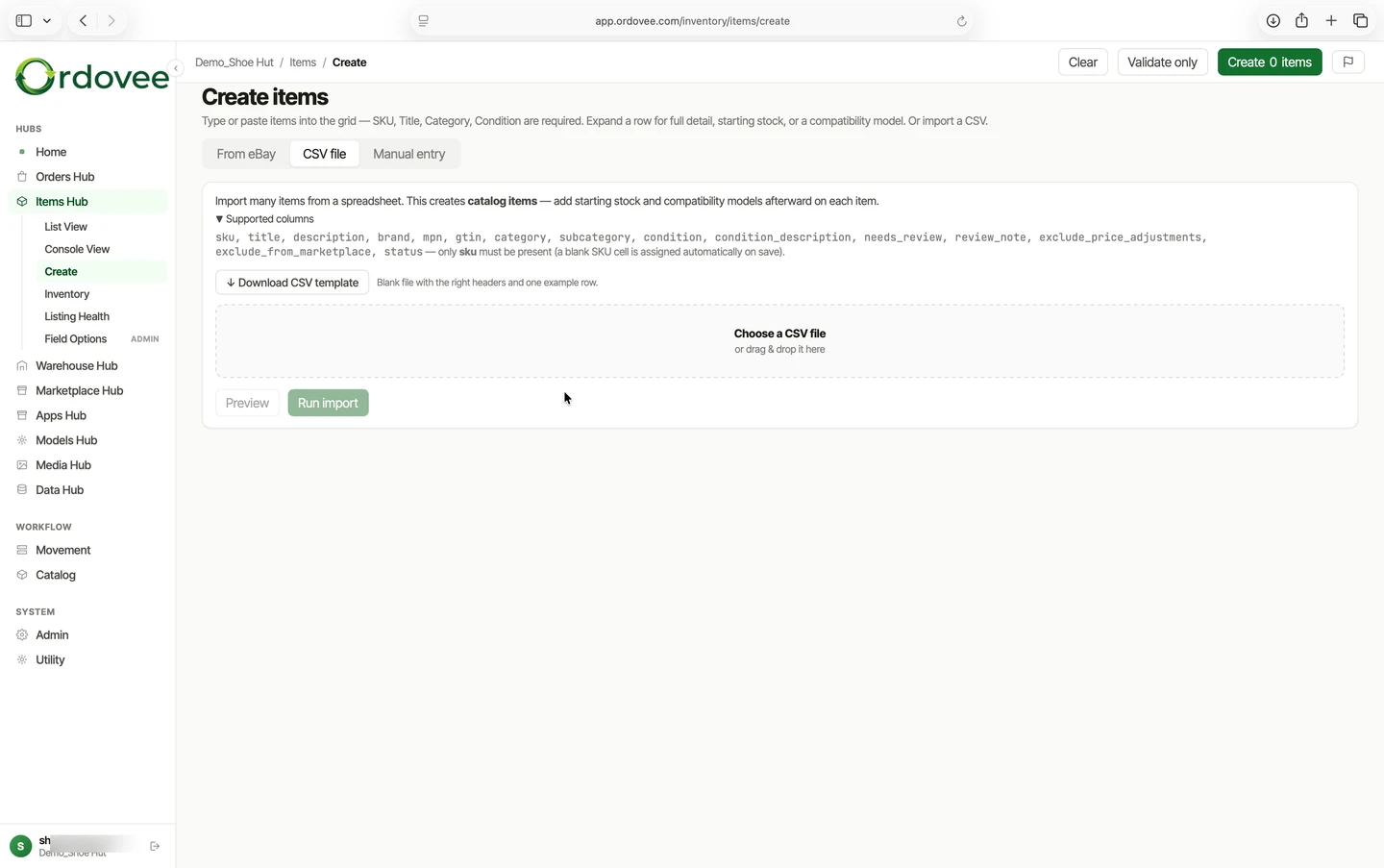
On the import page, Ordovee gives you a downloadable items template. That template includes the fields most shops actually need:
skutitledescriptionbrandmpngtincategorysubcategoryconditioncondition_descriptionneeds_reviewreview_noteexclude_price_adjustmentsexclude_from_marketplacestatus
The only hard rule is that the sku column must exist in the file. The cells in that column can be blank if you want ODV to generate codes for you, but the column itself has to be there so ODV knows how to interpret the sheet.
This step is for item records in your catalog. It is not the inventory-count step. ODV separates those on purpose, so you can clean up your items first and load quantities afterward.
Preview before you import
Once the file is uploaded, click Preview. Ordovee reads the sheet and shows you what will happen without changing live data.
The preview screen breaks the file into practical counts:
- Valid Rows and Invalid Rows
- To Create
- To Update
- To Restore
- To Archive
- Auto-SKUs to Generate
- Unchanged
That matters because you are not guessing. If the file says it will create 240 items, update 18, and archive 0, you know what you are approving. If the numbers look wrong, you stop there and fix the file.
ODV also keeps the Run Import button disabled when the file still has blocking errors. The cleanup happens before the import, not after it.
See this in action -> Import your first file on the product overview ->
What does Ordovee catch before anything changes?
The review step is where most of the risk goes away. ODV checks the file before it touches your data.
- Missing required structure: If the file does not include the
skuheader, ODV stops immediately. - Bad status values: The
statuscolumn must beactive,archived, or blank. - Bad true/false fields: Review flags and marketplace exclusion fields are validated before import.
- Duplicate SKUs inside the same file: ODV keeps the first row and skips later duplicates instead of quietly importing conflicting entries.
- Possible leading-zero damage: If a numeric SKU in the CSV may have lost zeros in Excel, ODV warns you before you create a mismatch.
- Duplicate MPN safeguard: If a new row would create an item whose MPN already belongs to another active item, ODV skips that row and lists it as a warning.
If the file has a long list of problems, ODV shows the first batch in the screen and lets you export the full issues list as a CSV. That gives you something clean to hand back to whoever owns the source spreadsheet.
Blank SKUs are allowed
Some shops already have a clean SKU system. Some do not. Ordovee supports both.
If the sku column is present but some cells are blank, ODV can generate new codes during import — sequential six-digit numbers such as 100001. That means missing SKUs do not have to block the whole project.
If you already have a naming system your team knows, keep it. If you do not, let ODV generate the missing codes and then build consistency from there. If you need help deciding which route makes sense, start with SKU strategy — why your SKUs matter in Ordovee.
Choose the right import mode
For normal day-to-day imports, use Add/Update (UPSERT). That mode is the safe default:
- New items get created
- Existing items get updated
- Archived items can be restored if the file marks them active
There is also a Replace mode for admins. Replace is for the rare case where the CSV is your full system of record and you want Ordovee to archive active items that are not in the file.
Use Replace only when the file is complete. If you are importing one category, one supplier list, or one cleanup batch, stay with UPSERT.
What a good first import looks like
The best first import is not your entire business in one shot. It is a clean, controlled batch.
- Export the spreadsheet you trust most.
- Keep the columns you actually need and line them up with Ordovee’s template.
- Leave blank SKU cells blank if you want ODV to generate them.
- Preview the file and review the counts.
- Fix warnings and errors before you run anything.
- Import a manageable batch first, then expand once the workflow feels right.
That is the same thinking behind Warehouse Organization, One Shelf at a Time. You do not need a perfect warehouse or a perfect spreadsheet to start. You need one clean batch that proves the process.
After the import
Once your item records are in Ordovee, the next step is loading inventory into locations and connecting the rest of your workflow. Your imported items become the base for labels, picking, order matching, and marketplace sync. When you are ready to push those parts out to your channels, Setting Up eBay and Shopify Sync in Ordovee picks up right where this import leaves off.
If you are moving off spreadsheets, that first clean import is the moment the operation starts to feel real. Your data is in one place. Your team is looking at the same records. The cleanup work starts paying you back immediately.
If you want to see what that would look like with your actual file, we can walk through it with you and show exactly how ODV would handle the creates, updates, warnings, and next steps.
-> If your SKUs still need cleanup first: SKU strategy — why your SKUs matter in Ordovee -> If you want a gradual rollout instead of an all-at-once project: Warehouse Organization, One Shelf at a Time -> See how the full inventory system fits together: Product Overview -> Want help importing your first file? Let’s talk
See Ordovee in your operation.
The fastest way to know if ODV fits your shop is to see the workflow with your own data — no slides, no scripted demo.