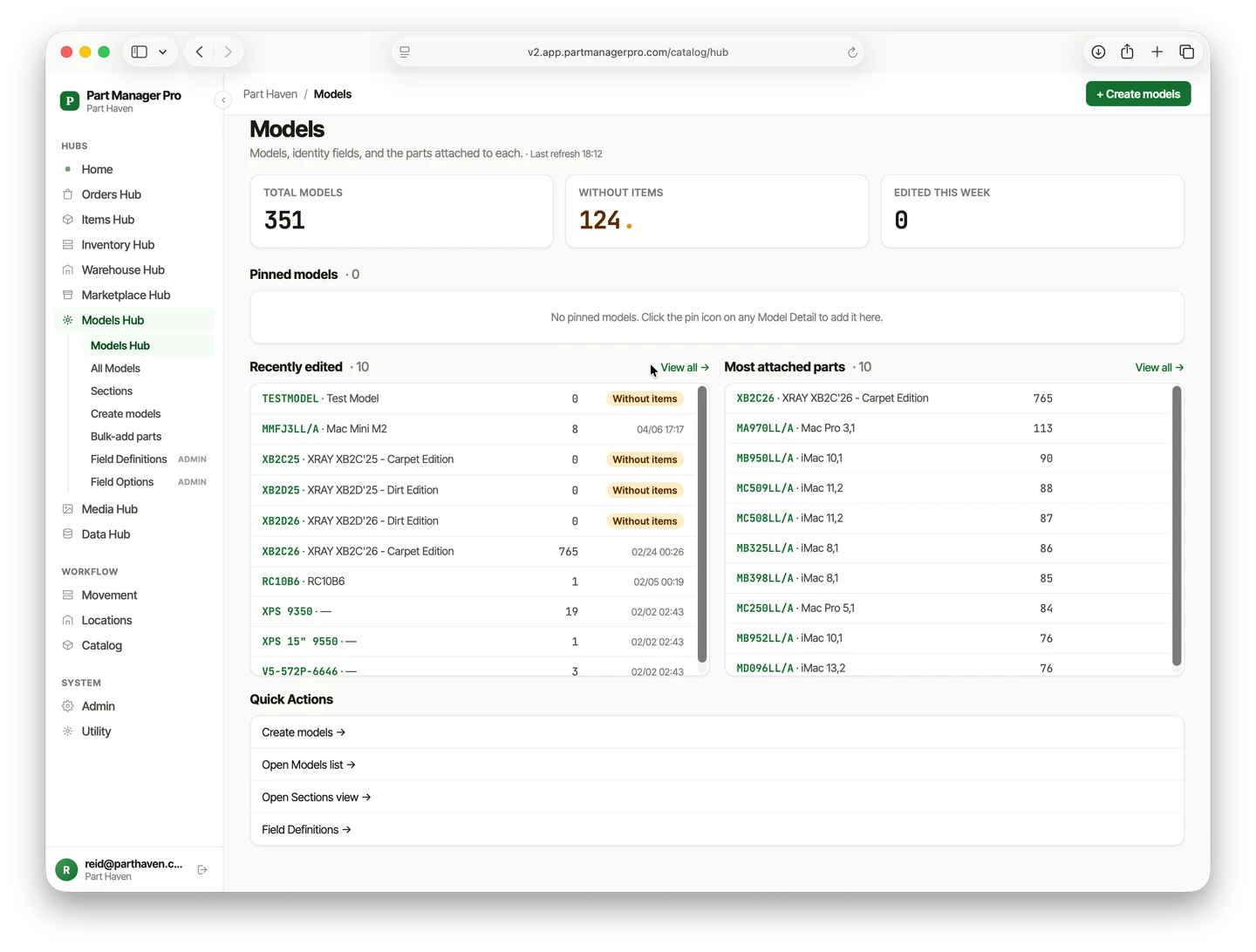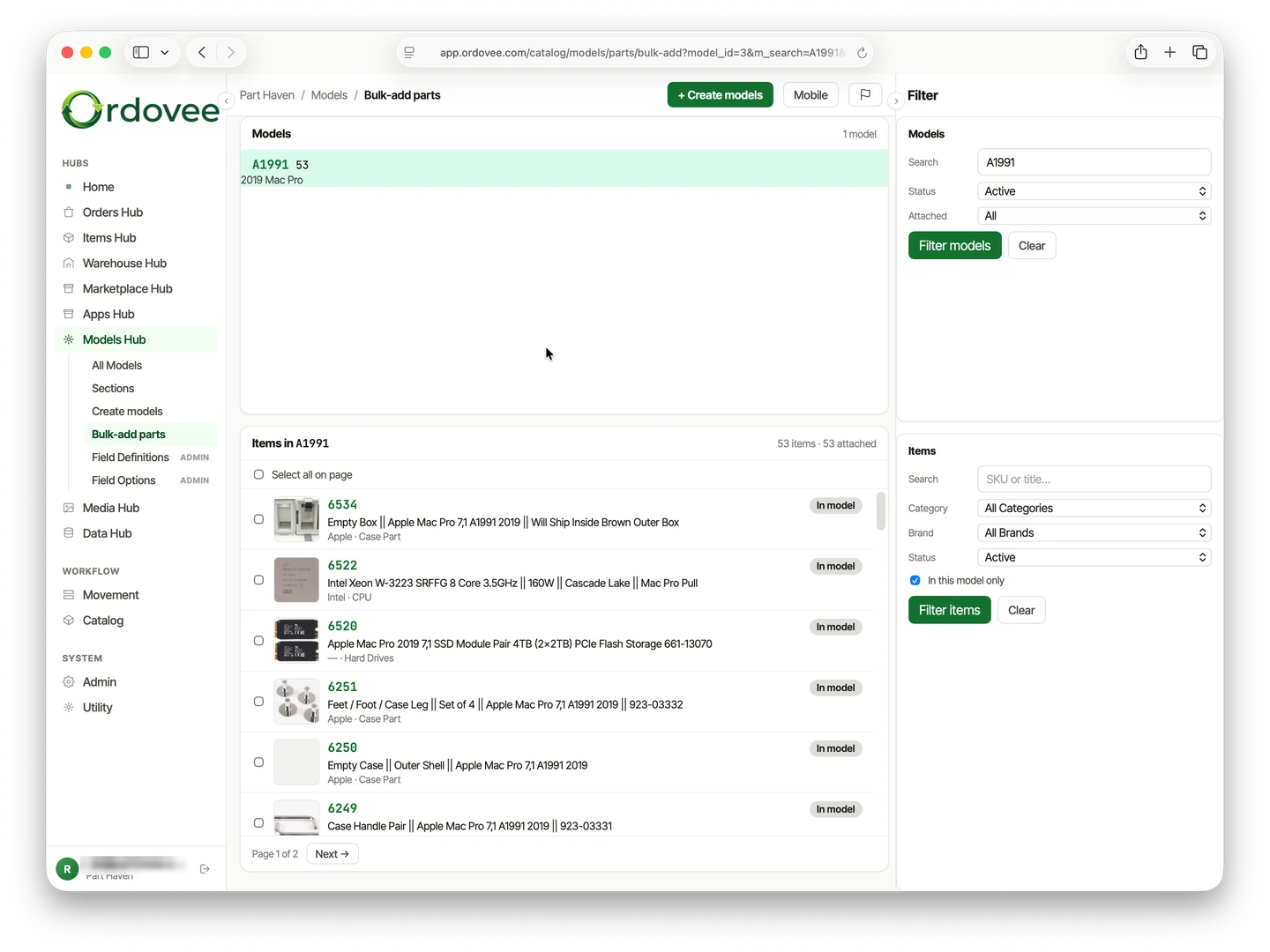
Every part in your operation needs a name your entire team agrees on. Not a description. Not a bin location. A short, consistent identifier that means the same thing on the shelf, on the screen, and on the marketplace listing. That identifier is the SKU.
Get this wrong — or skip it entirely — and problems start showing up downstream. Orders may not match. Quantities may not sync. Your team ends up resolving identifiers that should have been unambiguous — arguing about whether ALT-1234, alt-1234, and Alt-1234 are the same part or three different ones.
They shouldn’t have to guess.
What a SKU actually does in Ordovee
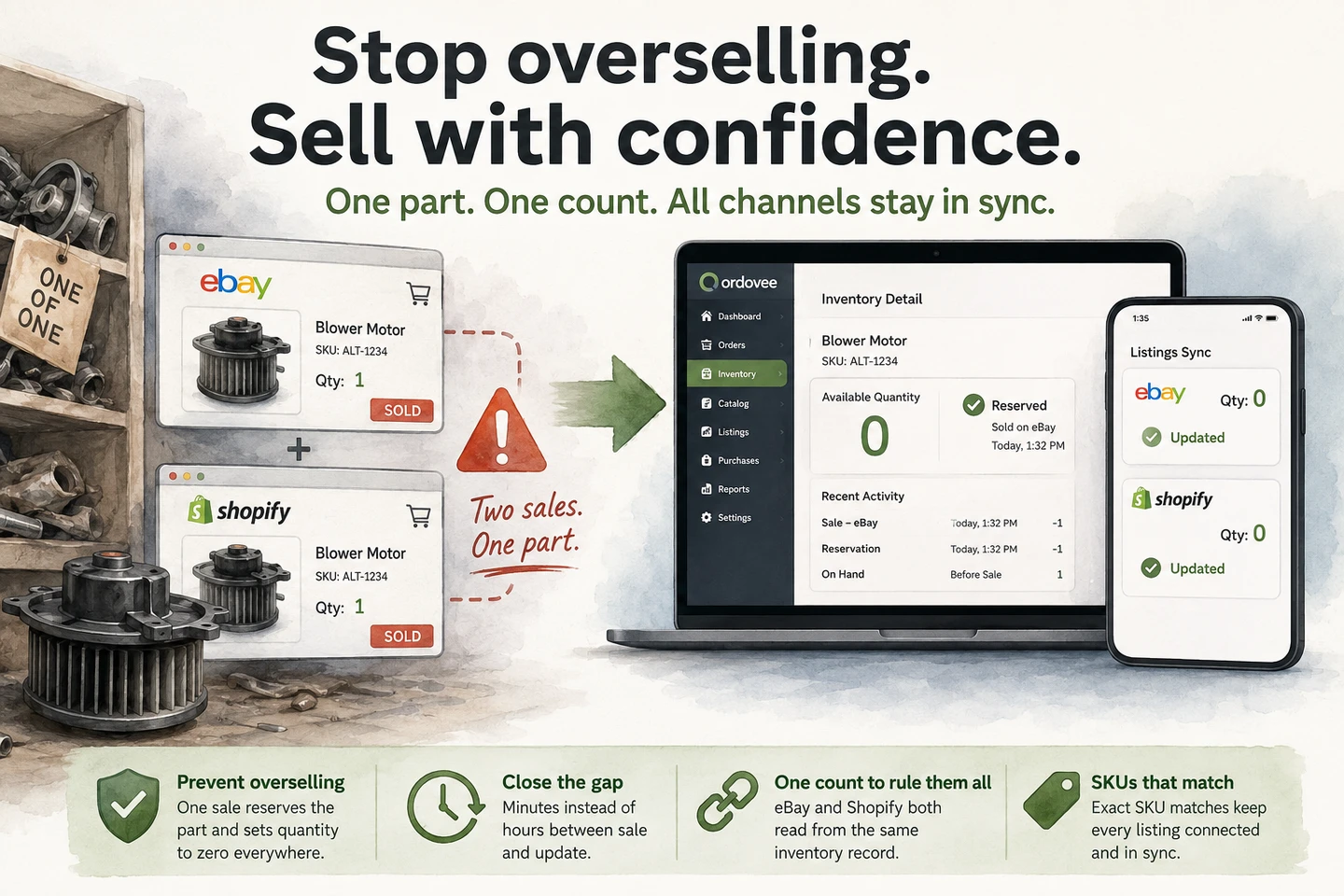
In ODV, the SKU is the thread that connects everything. Your item catalog, your inventory counts, your eBay and Shopify listings, your orders, your pick lists, your labels — they all reference the same SKU.
When an order comes in from eBay, ODV looks at the SKU on each line item and matches it to your internal catalog. If the SKU matches, ODV can connect the order line to the right catalog item automatically: inventory is reserved, the order enters the picking workflow, and your team knows what to pull.
If the SKU doesn’t match — because the listing never had one, or someone typed it differently — that order lands in an exceptions queue. Now a person has to stop what they’re doing, figure out which part the buyer actually ordered, and fix the match by hand. At volume, that manual triage becomes its own recurring workload.
Ordovee normalizes every SKU automatically
Here’s something ODV handles for you: normalization. Every SKU that enters ODV is normalized the same way: leading and trailing spaces are trimmed, and letters are converted to uppercase.
alt-1234, ALT-1234, and Alt-1234 all resolve to ALT-1234: one normalized identifier instead of three variations.
This matters more than most people realize. Spreadsheet operations accumulate inconsistencies over months and years. Someone copies a SKU from an email and picks up a trailing space. Another person types it in lowercase. A third pastes it from eBay where the format was different. By the time you move to real software, you’ve got three “different” parts that are actually the same thing sitting on the same shelf.
ODV eliminates those case and whitespace variations at the boundary. Every SKU is normalized the moment it enters the system, and ODV stores and matches against that normalized value.
One SKU per part, per account
Each SKU in Ordovee is unique within your account. You can’t create two items with the same SKU — the system won’t allow it, no matter how the SKU gets in: typed, imported, or pulled from a marketplace.
Why does that matter? Because when ODV sees SKU ALT-1234 on an incoming eBay order, there is exactly one item record it can match to. No ambiguity. No “which ALT-1234 did they mean?”
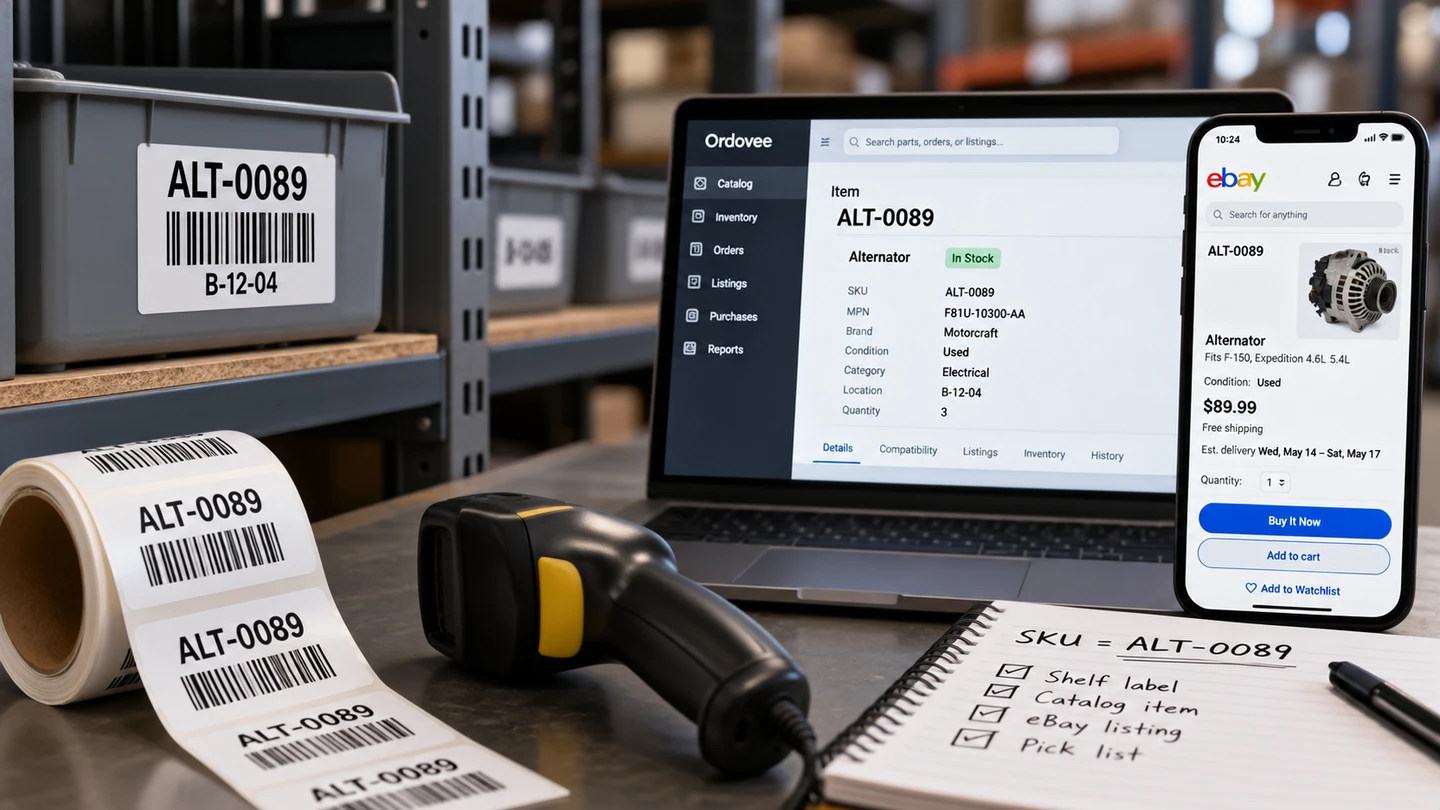
Labels, pick lists, and inventory activity resolve against that same record. Scan a part label and ODV can resolve the item; scan a location label and ODV knows where inventory is being picked from or moved to.
See how SKU matching drives the full order pipeline Walk through the product overview
Is the SKU the part number?
No. In Ordovee, the SKU identifies the sellable inventory record; the manufacturer part number identifies the design. One is yours and names a record in your account; the other is the manufacturer’s and names a design. Two pumps built to the same specification share a manufacturer part number; each still gets its own SKU, and that is what keeps their condition, history and location apart.
ODV keeps both on the part’s record, separately: the SKU, unique within your account, and the manufacturer part number beside it, with a GTIN if the part carries one. The brand, the category, the condition and a condition description sit on the same record, so what you know about this pump — the model of the donor unit it came off, a scuff on the housing — lives with its SKU instead of being squeezed into the number itself. The cross-reference then links the part to every model it fits, so “what do you have for this model?” comes back as the SKUs actually on the shelf.
What happens when you don’t have SKUs in place
This is where shops get stuck. They connect their eBay account, run the first sync, and discover that half their listings have no SKU — or have SKUs that don’t match anything in their catalog.
Here’s what that looks like in practice:
- Orders arrive but don’t match. Every unmatched order line needs manual triage. Your team goes from processing orders to investigating them.
- Quantities can’t push to eBay. Ordovee syncs your inventory counts to your marketplace listings by SKU. No SKU on the listing means no quantity sync — which means you’re still at risk of overselling.
- Pick lists have gaps. A picker sees an order for a part with no catalog match. They can’t confirm what to pull. They come find you to ask.
- The listing can’t connect cleanly to inventory. A missing or unmatched marketplace SKU prevents ODV from knowing which catalog item that listing represents. Until the match is resolved, orders and quantity updates for that listing need attention.
Every one of these problems traces back to the same root cause: the SKU wasn’t there, or it wasn’t consistent.
Ordovee can generate SKUs for you
If you’re starting from scratch — or if your eBay listings don’t have SKUs — ODV can generate them automatically. The system assigns sequential six-digit codes (100001, 100002, and so on) that are guaranteed unique within your account.
This works well for two scenarios:
- New items with no existing numbering. You’re building a catalog for the first time and just need consistent identifiers. Let ODV assign them.
- eBay listings that never had SKUs. ODV’s Fix Missing SKUs tool can assign identifiers to blank eBay listings and prepare the update that links those listings to inventory.
One exception: if multiple eBay listings represent the same physical part, assign their shared SKU deliberately. Do not use Fix Missing SKUs on those listings, because the tool gives each blank listing a new identifier.
If you already have a numbering system that your team knows, use it. Import your existing SKUs through a CSV import or enter them when creating items. ODV does not require a category-coded SKU scheme. Sequential numbers, prefixes, or an existing internal format can all work, as long as the values are unique and consistent.
Building a good SKU system
There’s no single right format, but good SKUs share a few traits:
- Short enough to read at a glance. If your team can’t read or enter it easily, it’s probably too long.
- Consistent format. Pick a pattern and stick with it.
BRK-0412andALT-0089tell your team more thanBrake_Rotor_Ford_F150_2018and12345. - Prefer letters, numbers, and simple separators. Hyphens are easy to read and broadly compatible. Spaces and unusual symbols can create search or integration problems across systems, so simple alphanumeric SKUs are easier to carry from Ordovee to marketplaces, labels, and imports.
- Not the same as your description. The SKU is an identifier, not a name. Your item title holds the description. Your SKU holds the lookup code.
Some shops use a category prefix (BRK for brakes, ALT for alternators, FAN for fans). Others use straight sequential numbers. Either works. What doesn’t work is having no system at all — or a system that three people follow differently.
When to get SKUs right: before you go live
The best time to establish your SKU strategy is before you import your first item, connect your first marketplace, or process your first order. Here’s why:
Renumbering after go-live creates cleanup work. Once SKUs are in use across listings, labels, orders, and warehouse workflows, changing them means updating those connected surfaces and reconciling anything that still carries the old identifier.
Marketplace listings become linked through their SKUs. Once your catalog and listings are aligned, changing the identifier later means updating those connections and checking that quantity sync still resolves to the right item.
Your team builds muscle memory. Once your team learns that ALT-0089 identifies a particular alternator record, that identifier becomes part of the daily workflow. Renumbering later introduces unnecessary friction across labels, listings, and picking.
The checklist is short:
- Decide on a format. Prefix + number, straight sequential, or import what you already have.
- Clean your existing data. If you’re importing from a spreadsheet, deduplicate and standardize before importing. Remove trailing spaces, pick one casing, merge duplicate entries.
- Assign SKUs to marketplace listings. Make sure every active eBay and Shopify listing has a SKU that matches your catalog. For blank eBay listings, Ordovee’s Fix Missing SKUs tool can help assign identifiers.
- Label parts and locations. Put the SKU on the part label and the location code on the shelf, rack, or bin label. What your team scans on the warehouse floor should resolve to the same records ODV uses on screen.
Do this before going live and you start clean. Skip it and your rollout begins with data cleanup that could have been handled beforehand.
Why aren’t my eBay and Shopify listings syncing?
A common cause is a missing or unmatched SKU. ODV trims leading and trailing spaces and normalizes case before matching, so alt-1234 and ALT-1234 resolve to the same value. But ALT-1234 and ALT 1234 are still different identifiers. Listings whose normalized SKU matches no catalog item are flagged for review. Correct the identifier, then let the relevant listing or marketplace sync refresh the match.
The SKU is one of the simplest pieces of your operation, but it has an outsized job: it connects the record on your shelf to the record on your screen and the line item on your customer’s order. Get the SKU foundation right, and the rest of Ordovee has a clean identifier to build on.
If you’re planning a move to ODV and want to make sure your SKU strategy is solid before you start, we’ll walk through it with you — using your actual data, your actual listings, your actual warehouse layout.
-> See how SKUs connect inventory, orders, and marketplace sync: Product Overview -> Have questions about setting up your SKU system? Let’s talk
See Ordovee in your operation.
The fastest way to know if ODV fits your shop is to see the workflow with your own data — no slides, no scripted demo.