
How Ordovee brings structure
to your operation.
Track every part, know where it is, document what it fits, and move orders from marketplace to shipment in one system. ODV brings your inventory, catalog, and warehouse workflow together in three connected layers.
SKUs, locations, compatibility, handheld workflows, and eBay and Shopify sync all work from the same operational record.
One view of what you have, where it is, and what changed.
The system tracks what exists, where it is, and what changed. Current counts and movement history are visible from the same inventory record.
Inventory visibility
Every scan, pick, and adjustment updates ODV’s ledger as it is recorded, so the warehouse and back office work from the same inventory state.
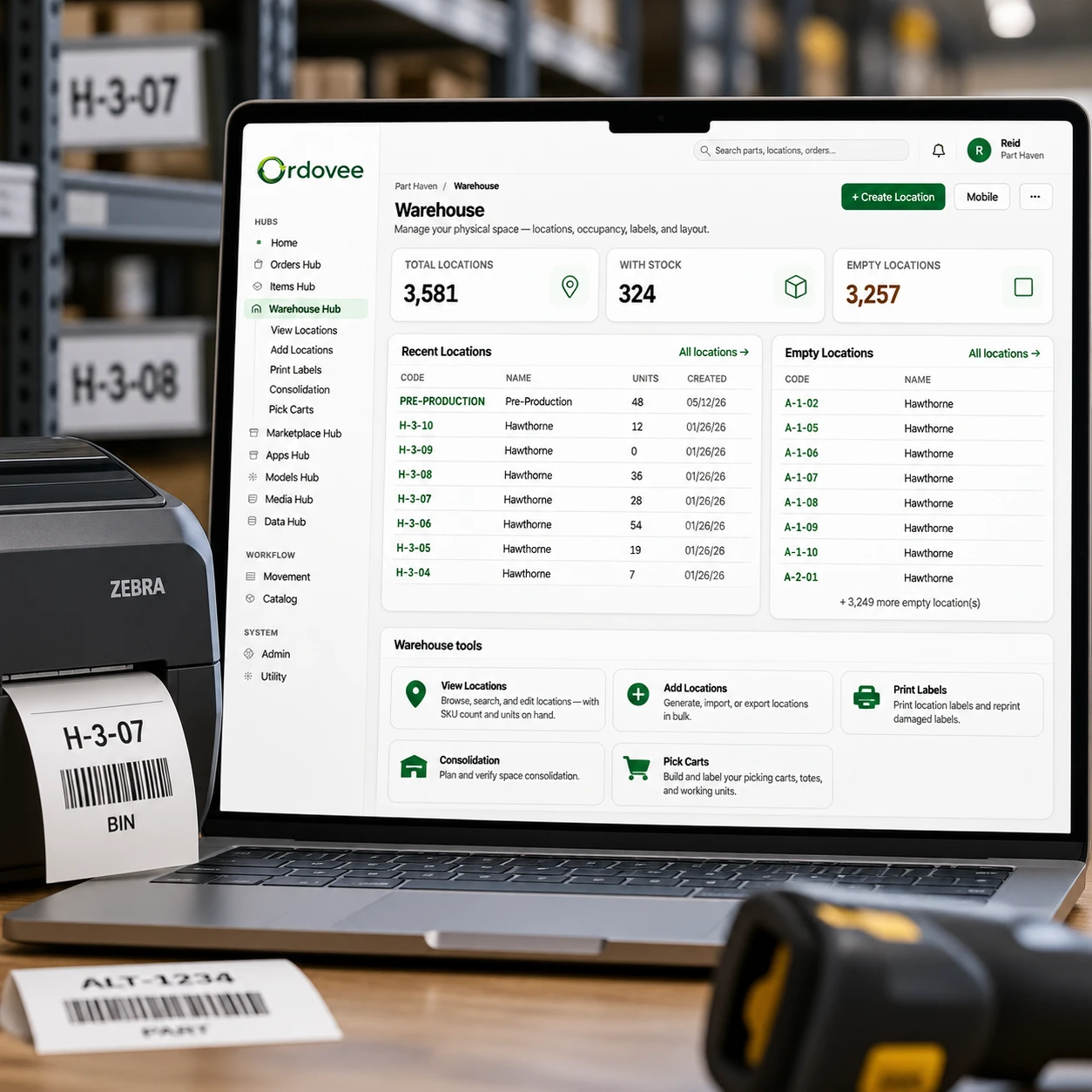
Coded storage locations
Wherever you keep your inventory, map it once. Every spot — a shelf, bin, rack, or second building — gets a location code, and ODV tracks the inventory stored there.
Inventory history
A ledger of every add, remove, transfer, and adjustment — recorded with who did it and when, with reasons captured for stock adjustments. A clear record you can follow.
Labels & barcodes
Generate barcode labels for parts and locations and print them from ODV to your thermal printer.
The catalog you build, not the one you license.
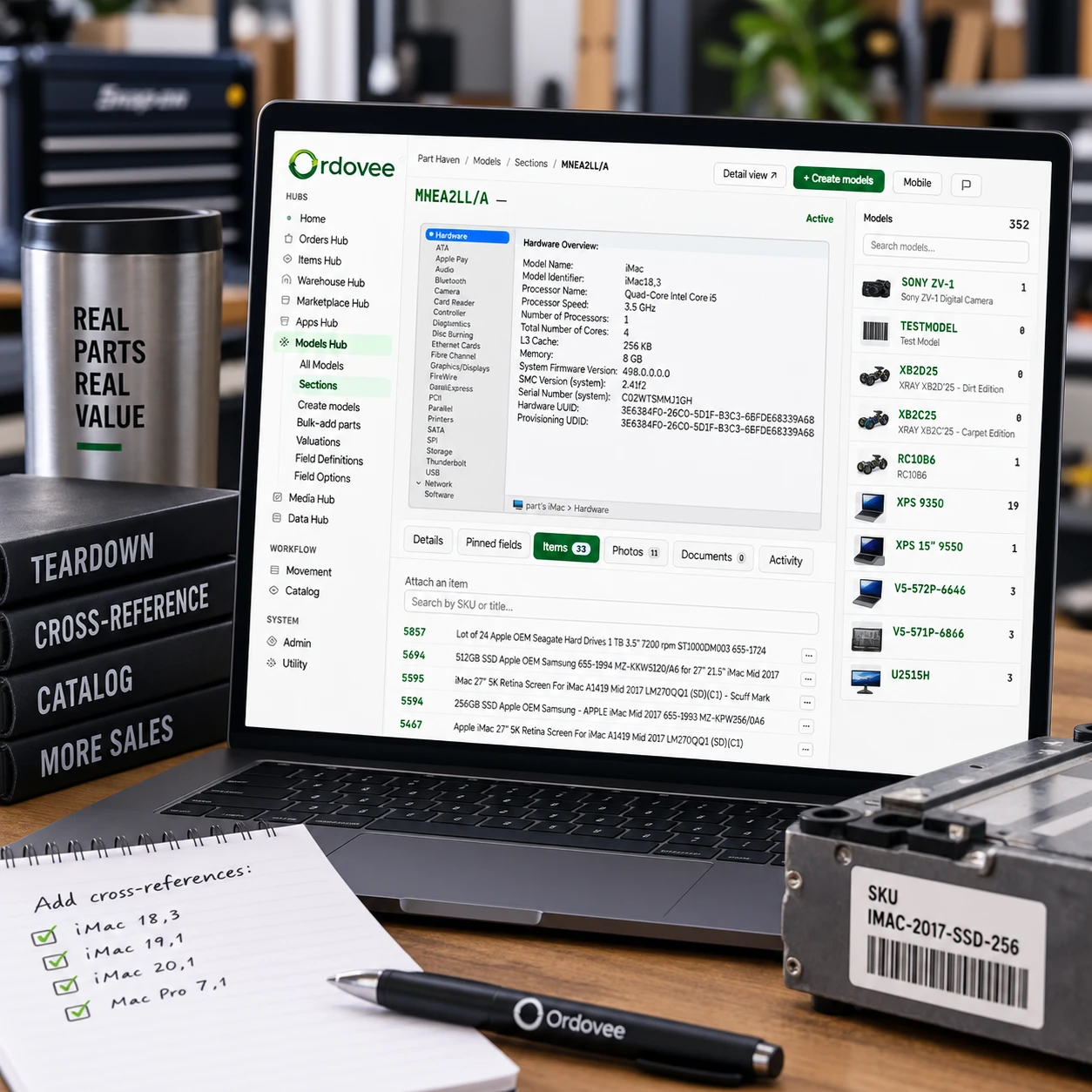
Your knowledge is one of your most valuable resources — and historically one of the hardest to capture. Ordovee turns that knowledge into a searchable catalog: as you work, parts are linked to the assemblies and models they fit. The cross-reference grows from records your team creates and verifies, and it remains yours to export at any time. See how shops build a spare-parts catalog from what crosses the bench.
Part ↔ Source Assembly cross-reference
Parts are linked to the assemblies they fit — starting with the one they came off. ODV organizes those relationships so you can search from either direction.
Your work, our system
Cross-references come from your own teardowns and verification, not from a third-party feed. Your team decides which relationships belong in the catalog.
Knowledge retained
Knowledge that once lived in memory and person-to-person training now lives in a searchable record your team can return to later.
Export any time
Full CSV export of parts, source assemblies, and cross-references — one row per part-to-assembly pair, so the relationships remain intact in the export. Your data, in an open format, whenever you need it.
Orders in, shipments out — one workflow from start to finish.
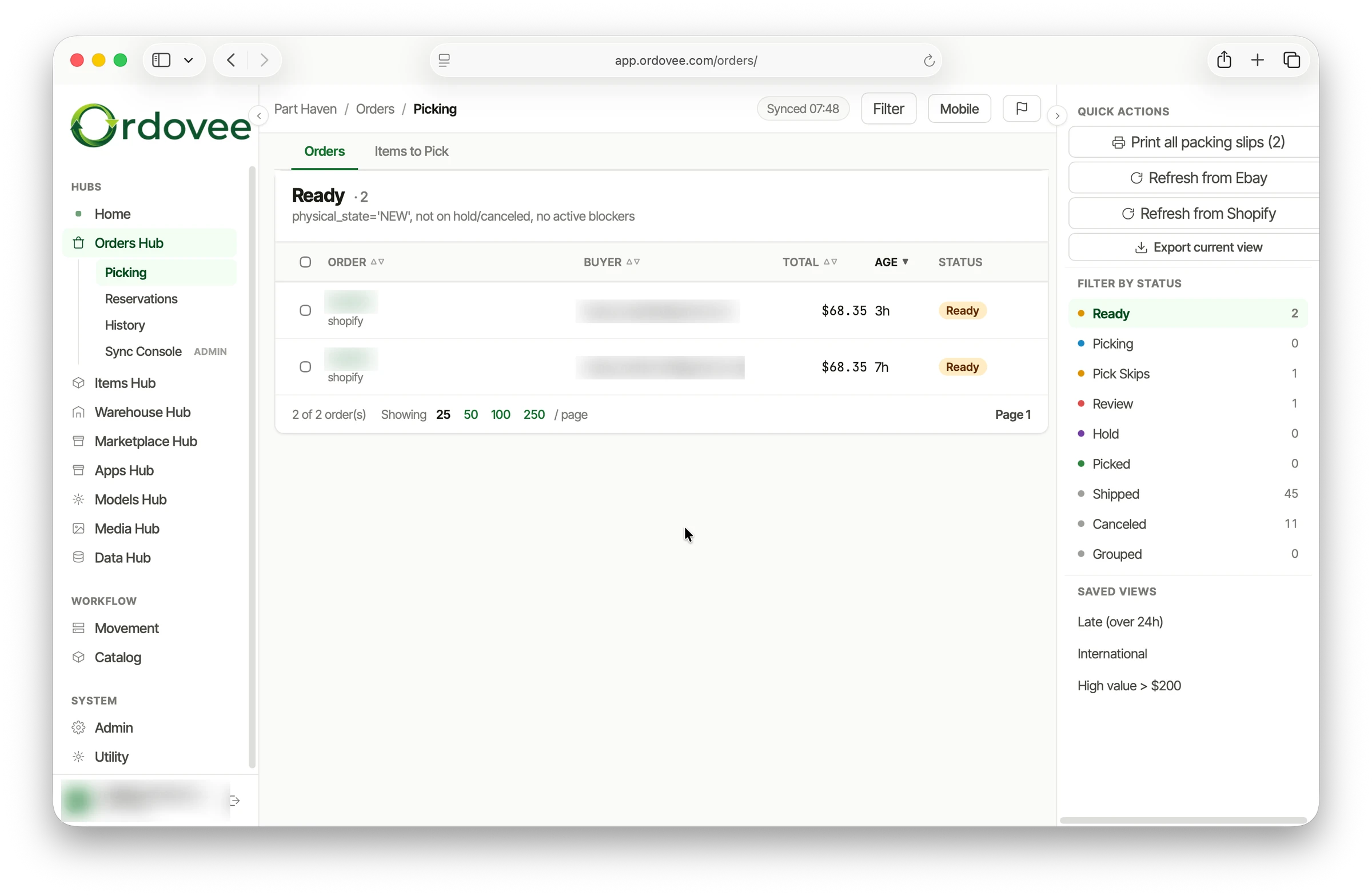
Orders follow one consistent path — in from your marketplaces, quantities reserved when Ordovee receives the order, picked and packed on the handheld, then shipped to your customer. With auto-push enabled, resulting quantity changes are sent back to matched marketplace listings.
Order import
Orders from your connected marketplaces are placed into one queue, with line items matched to parts in your warehouse.
Reserved for the order
When ODV receives an order, it reserves the required quantities inside the system. That inventory is no longer available to another order in ODV while marketplace quantities catch up on the next push.
Handheld picking
Pick each order with the handheld — scan the location, scan the part, drop it in the tote, scan the tote, move to the next order.
Marketplace sync
With auto-push enabled, inventory changes update ODV’s count and push the resulting quantity to matched eBay and Shopify listings. That keeps marketplace quantities aligned with ODV’s available inventory without requiring manual updates. If a count drifts, ODV flags it.
Ordovee is your system of record.
Your inventory, movement history, compatibility data, and workflow state live in ODV as the authoritative operational record. Marketplace orders can originate on eBay or Shopify; once ODV receives them, reservations, inventory movements, and resulting quantity changes are recorded against that same inventory.
Marketplace sync extends from that foundation. ODV does not silently rewrite inventory to match an outside number. Quantity updates start with recorded inventory events in ODV and flow outward to connected channels.
What Ordovee does — and where to learn more.
Open any capability for the guide that walks through it.
Your inventory, your catalog, your workflow — in one system.
Every account includes 3 hours of guided launch — we help you import your catalog, connect eBay and Shopify, and get your team scanning.