Why don’t used computer parts have an interchange? answers the title question historically: the economics never supported one. This guide asks the forward version — if the industry ever tried to build a shared interchange for electronics, what would it actually take?
The answer is worth walking through even for a shop that never intends to share a record, because every requirement on the list is something a shop’s own catalog needs anyway — at local scale, where it’s achievable today.
One thing to be clear about up front: Ordovee is not that interchange and is not trying to become one. ODV is the local system for the business that builds the catalog — each account’s compatibility data belongs to that business, stays in that business, and feeds nothing shared. What follows is industry analysis, not a roadmap.
Why a compatibility record needs a type
The core design problem is that “fits” is not one claim. A useful record has to distinguish at least five kinds of relationship:
- Observed source — this exact part was pulled from this exact source assembly.
- Specification match — dimensions and published specs appear compatible; nobody has proven it.
- Functional test — the part was installed or tested successfully in the target assembly.
- Conditional fit — works only with a certain revision, cable, firmware level, or configuration.
- Substitute / supersession — a different part number replaces the original, with known limits.
A spreadsheet cell that says “fits several Dell models” collapses all five into one untyped claim — which is exactly why spreadsheets produce wrong-fit returns. The confidence level is the data.
The ten requirements
1. Durable identity for the source assembly. Manufacturer, family, exact model, region, configuration, hardware revision, relevant serial range — specific enough to explain why two visually identical units don’t accept the same part.
2. Durable identity for the part. Every useful identifier: OEM number, contract-manufacturer number, board number, revision, superseded numbers, the shop’s own SKU — plus photos and measured attributes for the parts that arrive with no readable number at all.
3. Typed relationships. The five kinds above, never collapsed into yes/no.
4. Provenance and confidence. Who recorded the fit, when, on what evidence, and whether later users confirmed or disputed it. A cross-reference without provenance is a rumor with a database.
5. Functional and software conditions. Condition, test method, known faults, firmware or calibration requirements — and parts-pairing limits. The FTC has identified parts pairing, where a component needs manufacturer authorization before a device fully accepts it, as a real barrier to independent repair. A physically perfect fit can still be a failed repair; the record has to say so.
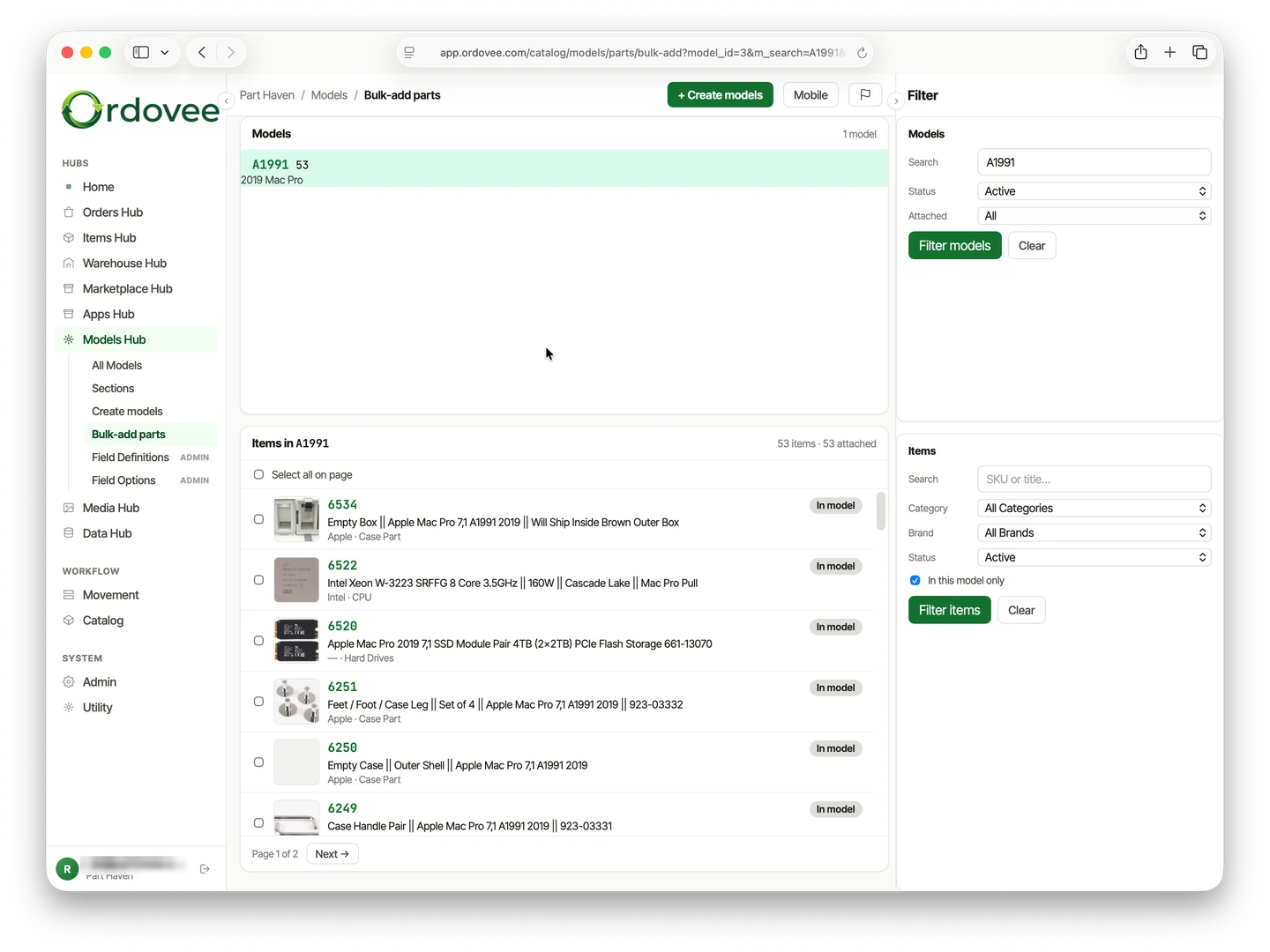
6. Capture during teardown. The evidence is strongest the moment the unit is open — label visible, donor known, revision in hand. A separate cataloging project always loses to the next pallet on the dock; a 2023 European case study found lifecycle information often exists but arrives shaped for other purposes, and end-of-life operators worried using it would slow processing. Capture has to be a byproduct of the work, or it doesn’t happen.
7. An open exchange format. The automotive lesson: a schema carries data, it doesn’t create knowledge — but without the schema, knowledge can’t travel. E-scrap would need both.
8. Governance, corrections, versioning. Fitment changes: numbers get superseded, a relationship that holds for one serial range fails in another. A credible shared record needs correction history and conflict resolution — which is an organization, not just a file format.
9. A reason to contribute. The shop doing the teardown pays for the verification; a shared system would have to return value to that shop first — or the highest-quality data rationally stays private, exactly where it is today.
10. Marketplace support. Structured compatibility fields outside the automotive categories, so verified fitment becomes searchable instead of text squeezed into a title.
Digital product passports: part of one requirement, not the answer
The EU’s Ecodesign for Sustainable Products Regulation points at requirement #1: digital product passports with persistent identifiers and machine-readable product data, potentially including repair, disassembly, and spare-parts information. That could someday take real friction out of identifying a source assembly.
But a passport is an identity, not an interchange. It addresses one requirement of ten. Product-level identity still has to connect to component identifiers, revisions, supersessions, and verified relationships — and verification is the part only the people handling the parts can supply.
The honest conclusion: private first
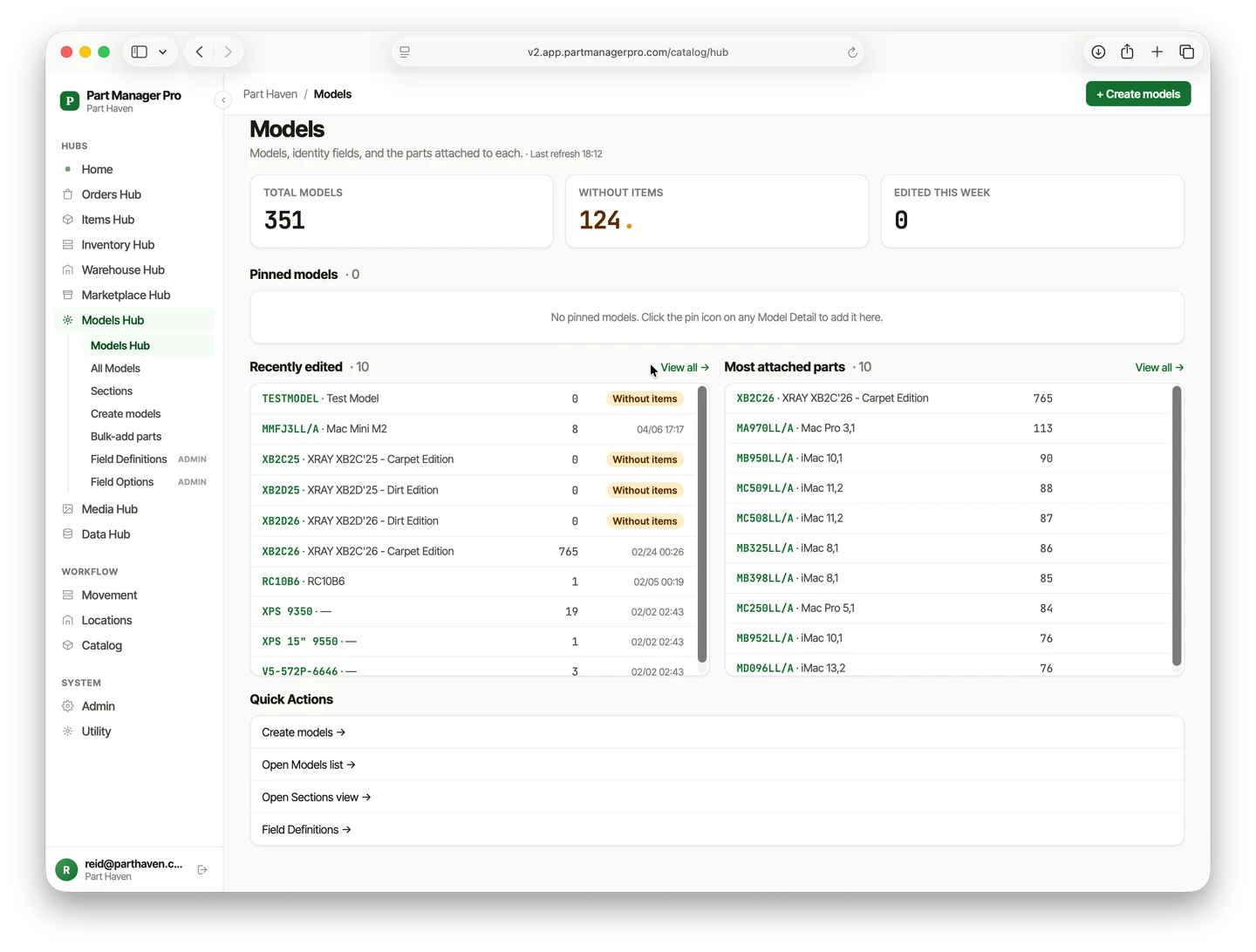
Look back down the list: identity, typed fits, provenance, conditions, capture-at-teardown. A shop needs every one of those for its own operation regardless of whether an industry system ever exists — and at the scale of one business, they’re all tractable. The identity problem shrinks to the units on your bench. The incentive problem disappears, because the shop doing the work keeps all of the value. The governance problem becomes your own record discipline.
That’s the layer ODV exists for: the private catalog, recorded at teardown, searchable from both directions, owned by the business that built it. If the industry ever assembles something shared, it will be someone else’s project with its own rules — and shops that kept structured records will be in the best position to evaluate it. Until then, the catalog that pays you back is the one on your own shelves.
→ The full argument: Why don’t used computer parts have an interchange? → The system that solved it for one industry: What automotive interchange actually solved → Start the private layer: Build your own parts catalog · Parts compatibility cross-reference → See how ODV handles the whole part lifecycle: Product overview → Thinking through your own record discipline? Let’s talk
Sources
- FTC testimony on parts pairing and repair restrictions
- EU Ecodesign for Sustainable Products Regulation
- Product lifecycle information flow in e-waste handling — Andersen and Halse
- Parts and accessories compatibility — eBay Developers Program
See Ordovee in your operation.
The fastest way to know if ODV fits your shop is to see the workflow with your own data — no slides, no scripted demo.