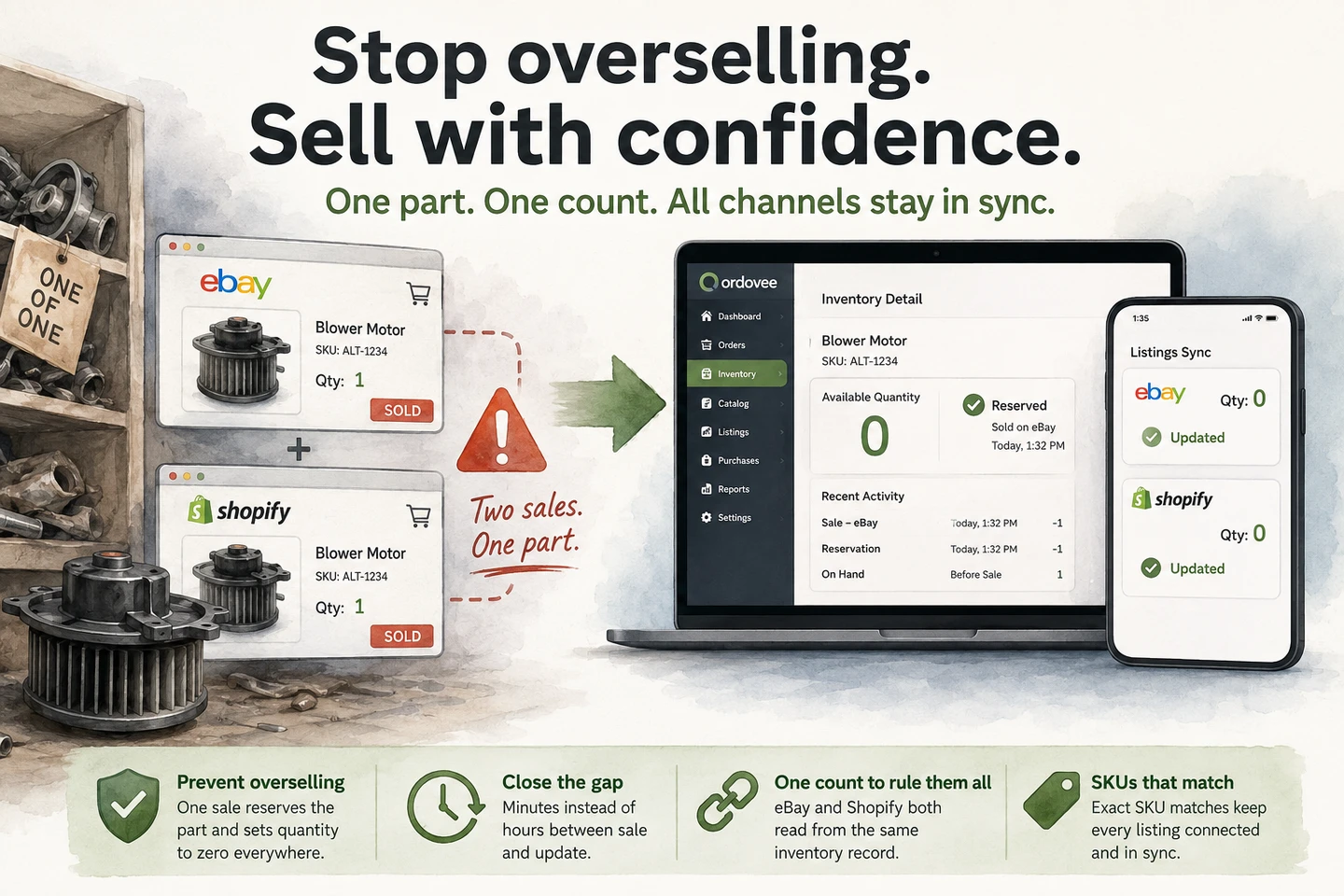
Two sale notifications land twenty minutes apart, both for the same SKU — one from eBay, one from your Shopify store. There is one blower motor on the shelf.
That is the overselling trap, and it hits parts sellers especially hard because so much of their inventory is one-of-one. Here is what an oversell costs, why it happens, and how a shared inventory count reduces the chance of it happening again.
Already had it happen? Here are a few tips for de-escalating it — the next fifteen minutes, before it turns into a refund you have to explain.
Why does selling one part on two channels cause an oversell?
eBay and Shopify each track only their own listings, and neither can see the other’s count. A part can sell on both before the other channel’s number moves, because neither channel knows the other exists.
Think of it as two scoreboards. eBay keeps its own number for a listing. Shopify keeps its own number for the matching product. When a buyer purchases on eBay, that channel does exactly what it should — it drops its own count. Nothing reaches across to Shopify to say the part is gone, so Shopify still shows one available, ready for the next buyer.
Does eBay stop you from overselling?
No. eBay works from one number: the quantity on your listing. If the listing says one is available, eBay accepts the order — even if that same part sold somewhere else a minute earlier. eBay has no window into your Shopify store, your warehouse, or the shelf where the part actually sits.
The setting sellers usually have in mind here is eBay’s out-of-stock control, and it solves a different problem. It keeps a Good ‘Til Cancelled listing alive when its quantity reaches zero — hidden from search until you restock, rather than ended — so the listing keeps its history and its item number. It protects the listing. It does nothing to stop a second sale, because it still only knows the quantity eBay holds for that one listing.
To catch that conflict automatically, you need a system that sees both channels at once — one count that both channels answer to.
What does an out-of-stock cancellation cost you on eBay?
The refund is the cheap part. eBay’s seller standards count an unexpected seller cancellation — for example, because the item is out of stock or was sold elsewhere — as a transaction defect. Defects feed your transaction defect rate, which eBay evaluates under its published seller standards. The seller standards policy carries the current requirements, and it is worth reading at the source rather than trusting anyone’s summary of it.
So the real cost of a double sale is more than the refund: there is the buyer conversation, the cleanup, the decision about which order you can fulfill, and potentially a defect on the account that lasts longer than the incident itself. That last one is why overselling is worth engineering out rather than absorbing.
Why one-of-a-kind parts get oversold fastest
Many multichannel inventory workflows assume you have stock depth or can reorder the item. A one-of-one part removes that cushion: the moment it sells on one channel, every other listing needs to move toward zero as quickly as possible.
A retailer with a hundred identical phone chargers has depth to spend — a late update costs them nothing, because the pile covers the gap. A teardown operation has no depth. Pull an alternator from a car, a screen from a laptop, a blower motor from an HVAC unit, a hydraulic valve from a tractor: each one is one-of-one until the next donor unit arrives. Every listing is a single-quantity listing, so every listing is one sale away from an oversell.
Ordovee treats this as the normal case rather than the exception. Structured Disassembly Management — the category ODV was designed for — assumes a catalog where most parts exist exactly once, and each has to come off every channel when it sells. That means the inventory count cannot live separately in each channel.
How do you stop overselling across eBay and Shopify?
The core way to reduce overselling across eBay and Shopify is to give both channels one inventory count to answer to, instead of letting each keep its own. Sell the part anywhere, and the shared count drops once ODV receives the sale; the updated quantity is then pushed to the other channel.
That is what a ledger-based inventory system gives you. Instead of a number living inside eBay and a second number living inside Shopify, one permanent ledger records every movement of every part — receipts, sales, transfers, adjustments — as dated line items. Your current quantity is derived from that record, and it is the system of record both channels answer to. The two scoreboards stop competing, because they are now two windows onto the same count.
How Ordovee narrows the overselling window
ODV sits between your channels and that single count. When a part sells:
- The order comes in. ODV imports the sale from the channel it happened on.
- The unit is reserved. ODV places a reservation against the part, which drops its available quantity to zero.
- The other channel is updated. ODV pushes the new quantity out to your other listing, so it stops offering a part you no longer have.
The reservation closes the availability window inside ODV. As soon as ODV receives the order, the unit’s available quantity drops to zero — it is no longer sellable, before anyone picks an item. The remaining exposure is the time it takes the other channel to receive the updated quantity.
That catch-up runs on two different clocks, and the difference matters:
| The part sells on… | ODV hears about it | The other listing updates |
|---|---|---|
| Shopify | On its own — Shopify sends the notice (webhook) | On the automation engine’s next push to eBay |
| eBay | On the next scheduled order sync — ODV has to ask | On the next push to Shopify, once ODV has the order |
A quantity push is still an update, and an update takes a moment to land, so the window never closes all the way to zero on either channel. It is shortest when the sale happens on Shopify and longest when it happens on eBay. What changes is the size — an automatic push instead of however long it takes you to remember to log in — which sharply reduces the exposure compared with updating quantities by hand. You do not have to take it on faith, either: every sync and every push is recorded with its time. The rhythm of eBay’s scheduled sync, and the button that pulls a change in on demand, is covered in a guide of its own.
Ready to narrow the window on your own listings? — connect eBay to ODV or connect your Shopify store; each takes about ten minutes.
Why do your eBay and Shopify SKUs have to match?
For a sale on one channel to zero out the other, Ordovee has to know the two listings are the same part — and it knows that by SKU. The SKU on your eBay listing and the SKU on your Shopify product have to point at the same item — and one physical part must not carry two different SKUs. List it as ALT-1234 on eBay and ALT-1234-B on Shopify and ODV reads two parts of one each, so both can sell. One part, one SKU, every channel.
ODV normalizes SKUs by trimming spaces and converting them to uppercase, then matches the normalized values, so alt-1234, ALT-1234, and Alt-1234 all resolve to the same part. What it will not do is guess. If a listing’s SKU matches nothing in your catalog, ODV cannot link it — so it surfaces that listing in the listing coverage view, the running list of live listings not yet matched to an item. That is the screen to check when a quantity is not moving: a listing with no match never receives a push.
Where an eBay listing never had a SKU at all, ODV’s Fix Missing SKUs tools assign one and prepare the update for eBay. That identifier is the only field ODV touches — your titles, prices, photos, and categories stay exactly as you wrote them. A clean SKU plan is the foundation the whole guard stands on, and the SKU strategy guide covers building one your whole team agrees on.
One part, three eBay listings — what happens when one sells?
Sellers do this on purpose: the same control board fits a Whirlpool, a Maytag and a Kenmore, so it goes up three times, one listing titled for each brand, to catch each buyer’s search. There is still one board on the shelf. The question is what the other two listings do when the first one sells.
In Ordovee, all three are pushed to zero from the same count — as long as all three carry the same SKU. ODV keeps one number per SKU: the item’s total on hand, minus anything reserved for open orders. When it pushes to eBay, every listing on that account carrying the SKU is set to that number. Three listings, one number, one push. (Other tools do this with what they call shadow SKUs or alias SKUs; ODV uses the plain SKU on every listing and nothing else.)
Three things have to be true first, and the setup is on your side of the fence:
- Auto-push is enabled for the eBay connection. Auto-push is off by default, so ODV will not push quantities until you enable it.
- All three eBay listings carry the same SKU. You set that on eBay yourself. Do not use Fix Missing SKUs on these listings if you intend them to share inventory; the tool assigns a new SKU to each blank listing, and three SKUs means three items with three counts — the oversell setup, not protection from it.
- One item in ODV holds the true physical count. Three listings do not mean three units. If you record 3 on hand because there are three listings, ODV will push a quantity of 3 to each listing.
Two limits worth knowing. It happens on ODV’s next push, not the moment the listing sells — the sale reserves the stock first, so the part is off the market inside ODV before eBay catches up. And it is an eBay statement, for listings on the same eBay account. Shopify is different: ODV updates one Shopify variant per SKU, and a SKU that appears on two variants is left alone rather than guessed at. Whether eBay ends a listing at zero or keeps it live as out of stock is eBay’s setting, not ODV’s.
Closing the other ways a part goes missing
Shared inventory handles the channel-to-channel side of the problem, and the reservation covers the rest of the order — a part promised to a buyer becomes unavailable inside ODV before anyone picks it. But stock can still leave your operation in other ways, and they come down to one habit that Ordovee gives you the tools to keep: every part moves through the system.
The counter sale. A walk-in buys the alternator off the shelf. Record it in ODV — as a sale or an adjustment — and the part comes off your count and both listings update, exactly like a marketplace order; the counter is just another way a part sells. A counter sale that never reaches the system creates another inventory gap, so every part that leaves the building leaves through ODV. A cycle count on your fastest-moving locations is the backstop that keeps any drift measured in days, not months.
The broken part. If a part cracks during picking, it was already reserved inside ODV for its order. The normal channel-update window still applies until the new quantity reaches eBay or Shopify, but the unit is no longer available to another order inside ODV. The case to record is a part damaged while it is still on the shelf and listed: log the inventory adjustment at the bench, and ODV drops the count and updates both listings with it.
Common questions about overselling on eBay and Shopify
Does eBay stop you from overselling?
No. eBay sells against the quantity on your listing. If the listing says one is available, eBay accepts the order — even if that same part sold on another channel a minute earlier. eBay’s out-of-stock control is a different thing: it keeps a listing alive at zero quantity instead of ending it, which protects the listing’s history, not the buyer.
Does cancelling an order because a part is gone hurt my eBay account?
Yes. eBay’s seller standards count an unexpected seller cancellation — for example, because the item is out of stock or was sold elsewhere — as a transaction defect. Defects contribute to your transaction defect rate, which eBay evaluates under its published seller standards. The refund is the cheap part of an oversell; the defect is the part that follows you.
Does eBay automatically update when the same part sells on Shopify?
No. Each channel only knows its own listings. Zeroing the eBay listing when a Shopify buyer takes the part is the job of a system that reads both channels against one count — which matters most when that count is one.
How does the other listing get updated?
It depends on which channel the part sold on. A Shopify sale reaches Ordovee on its own, because Shopify sends the notice. An eBay sale reaches ODV on its next scheduled order sync. Either way, ODV then pushes the new quantity out to the other listing on the automation engine’s next pass — automatically, instead of however long it takes you to remember to log in.
Should I hold back a unit as a buffer so the count never reaches zero?
A buffer buys margin by keeping sellable stock off the market, and two buyers landing inside the same window will still collide. A shared count gives you that protection without permanently parking inventory: ODV works from the true available count and pushes that count out to both channels. The normal synchronization window still applies, but you are not deliberately withholding a sellable unit.
One count, one buyer
Overselling is a synchronization problem. Two systems keep two inventory numbers that were never introduced to each other, and a one-of-a-kind part gives those numbers no room for error. Ordovee gives both channels one count to answer to: a shared inventory record, a reservation when the order arrives, and updated quantities pushed back to eBay and Shopify.
If most of what you sell exists exactly once, shrinking the gap between a sale and the corresponding inventory update can mean fewer cancellations, fewer buyer conversations, and fewer opportunities for the same part to sell twice. Let’s find out together whether it fits how you sell.
→ Connect your channels, step by step: eBay sync setup · Shopify sync setup → See quantity sync alongside everything it touches: The full feature set → Have a channel setup you want to talk through? Ask about oversell protection
You already oversold — what do you do now?
Everything above is prevention. But if you landed on this page because both orders are already sitting in front of you, here is the next fifteen minutes.
- Before you cancel anything, check whether you have a second one. Search your catalog for the part, not the listing. The same blower motor may have come off a different donor unit last month under a different SKU — and if a second one fits, you may be able to fulfill both orders without cancelling either one. It is the only outcome where you keep both sales, so it is the first move rather than the last.
- If there really is only one, choose which order to keep — knowing the two cancellations cost different amounts. A cancellation on eBay for a part you cannot supply lands as a defect on your seller account — the cost this guide walked through above. A refund on your own store can leave you with unrecovered payment-processing fees, depending on how the order was paid, plus the customer conversation — but there is no marketplace seller-performance scorecard attached to the cancellation. That asymmetry is one factor to weigh. Weigh the buyer, too: a repeat wholesale buyer you will see again next month can be worth more than the metric.
- Tell the buyer quickly. Prompt communication gives you the best chance to resolve the problem cleanly. Do not let an order sit for days while the buyer assumes it is being fulfilled.
- Issue the refund promptly and explain clearly. Something like: “I’m sorry, and I want to be straight with you. The blower motor you bought sold on another channel just before your order came through, and I only had the one. Your full refund is on its way back now. If you’d like, I’ll message you the moment another one comes off a unit and hold it for you.” Put the money back before they ask for it, and skip the discount code offered in place of a refund.
- Correct the record as soon as possible. Cancel the order you cannot fill on the marketplace it came from — that is where the buyer is refunded and the sale ends — and Ordovee picks the cancellation up on its next order sync and releases the hold it had placed on the part. Then check the count itself: if ODV believed you had two, adjust it to what is on the shelf, with the reason, so the ledger holds the true number and the next push carries it to every listing. Otherwise the phantom unit is still in your count, still listed, and still available to a third buyer tomorrow.
- Then close the gap that let it through — the reservation, the shared count, one SKU per part. That is what everything above is for, and the difference between a bad fifteen minutes today and the same fifteen minutes next week.
See Ordovee in your operation.
The fastest way to know if ODV fits your shop is to see the workflow with your own data — no slides, no scripted demo.