Auto salvage runs on a lookup the rest of the parts world doesn’t have: pull a part from a wrecked vehicle, and the interchange says what else it fits — every make, model, and year — before the part reaches a shelf. In North America that lookup is the Hollander Interchange. Below is what the system actually consists of, because the details matter for every trade that wishes it had one.
This guide is a companion to Why don’t used computer parts have an interchange?, which covers why nothing comparable exists for electronics, appliances, or equipment.
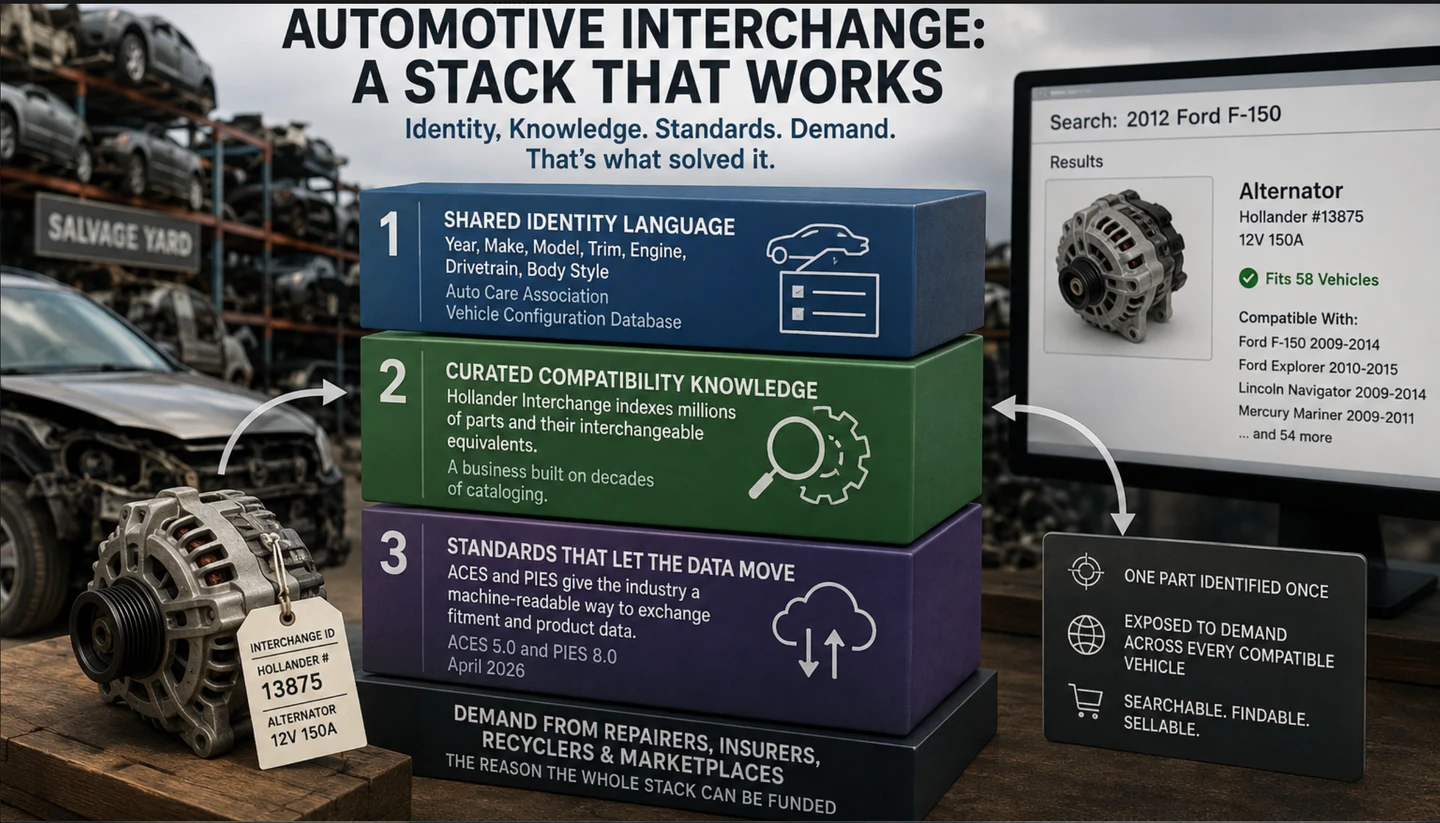
Interchange is a stack, not a database
The automotive market did not solve interchange with one product. It built three connected layers, and each one carries a different part of the load.
Layer one: a shared identity language
A vehicle enters the market with a durable, standardized identity: year, make, model, trim, engine, drivetrain, body style. The Auto Care Association maintains a Vehicle Configuration Database — a normalized reference layer that gives the whole industry the same way to describe the same vehicle.
That identity layer is the quiet foundation everything else stands on. A cross-reference is only as good as the identities it connects; vehicles have identities stable enough to index against for decades.
Layer two: curated compatibility knowledge
On top of that identity sits the interchange itself. Hollander Interchange indexes millions of auto parts and their interchangeable equivalents. A recycler identifies a pulled part once, inventories it under a known interchange record, and from that moment the part is exposed to demand from every compatible vehicle — including buyers searching for makes and models the yard never thought to mention.
This is the layer that took generations of accumulated cataloging work. It is a business, not a public utility: the data is licensed, maintained, and sold because the volume of the automotive trade can pay for it.
Layer three: standards that let the data move
Knowledge that can’t travel dies in one company’s system. The ACES and PIES standards give manufacturers, distributors, sellers, and marketplaces a machine-readable way to exchange fitment and product data — a common schema, maintained by an industry association and updated on a public cadence (ACES 5.0 and PIES 8.0 shipped in April 2026).
Marketplaces complete the loop. eBay’s structured parts-compatibility system for automotive categories lets a listing carry its fitment as searchable data — eBay’s own developer documentation notes this improves search relevance and frees titles from listing every compatible vehicle. A buyer searches for their truck; the listing surfaces because the fitment field says so.
The distinction that matters most
Here is a detail that can be missed, and the Auto Care Association states it plainly: a data standard is not fitment knowledge. ACES gives the industry a common way to communicate which vehicles a part fits. It does not tell anyone what fits — the seller still has to research, create, or buy that application data before the standard has anything to carry.
So automotive interchange works because both halves exist:
- A common structure for describing vehicles, parts, and compatibility — the standards.
- A reliable process and business model for creating the compatibility records themselves — the decades of cataloging that filled the structure.
Any trade that wants an interchange needs both. A schema with no verified records is an empty shelf; verified records with no schema are a private notebook.
Why this stack could be built for vehicles
The precondition is the one that gets skipped: an old car has always been worth repairing. A vehicle stays useful for decades, insurers pay to put damaged ones back on the road, and so demand for used parts — and for knowing what else a part fits — existed before anyone built a database to serve it. Fitment data had a paying customer from day one.
On top of that demand, three conditions made the stack fundable:
- High volume per part. A popular alternator fits years of production across multiple models — one interchange record serves thousands of transactions. A laptop hinge revision might fit four machines.
- Stable identity. A vehicle’s year/make/model survives its whole service life. A consumer-electronics model name can hide silent board revisions within one production year.
- A paying ecosystem. Repairers, insurers, recyclers, and marketplaces all transact against the same records, so the licensing model funds the upkeep.
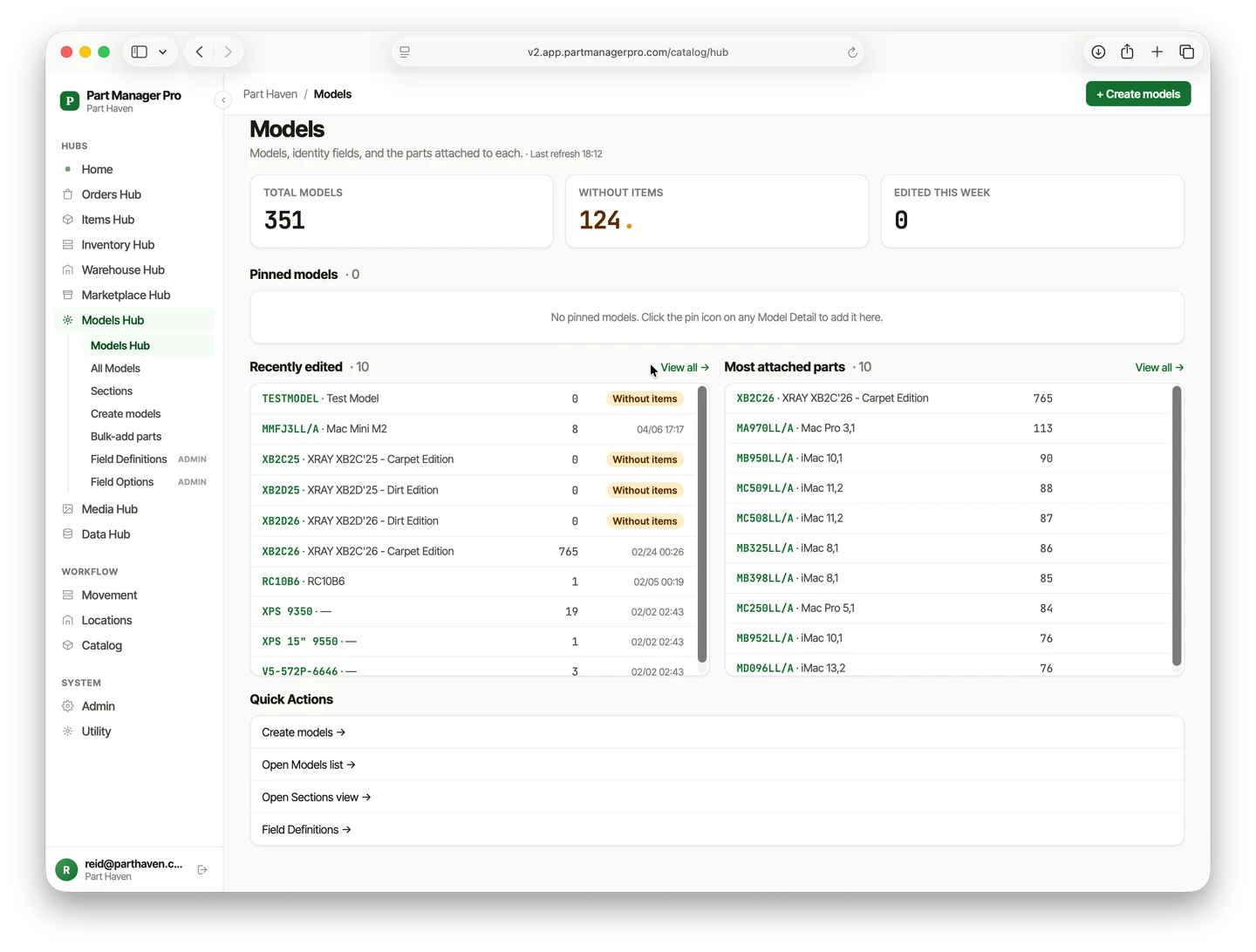
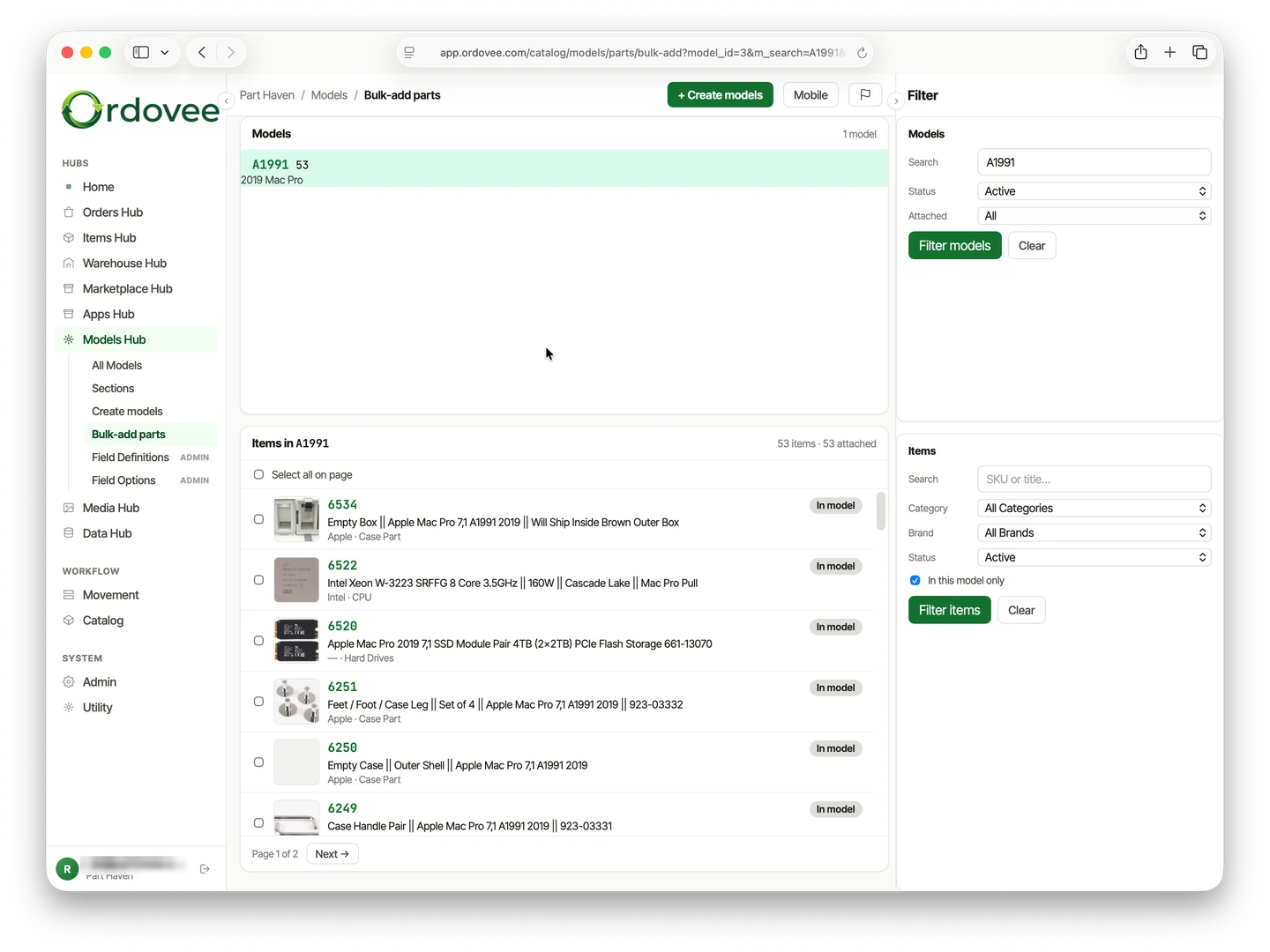
The companion guide covers why nothing comparable formed for electronics — the short version: for most of that industry’s life, an old computer was not worth repairing, so the demand this whole stack answers simply never arrived — and what a shop can do about it locally: record compatibility at teardown, in the shop’s own catalog, where the identity problem shrinks to the units actually on the bench. That record is scoped to one business and owned by it — it exists so the shop doing the verifying keeps the value of the verification. If you want the forward version of the question — what a parts interchange outside auto would actually have to solve before it could work — the ten requirements are worth reading against this stack.
Automotive interchange looks like a database from the outside. From the inside it is an identity layer, a curated knowledge business, and an exchange standard — built over generations because an old vehicle was always worth fixing, and the repair demand that follows from that could pay for all three. That’s the honest benchmark for every other parts trade: not “someone should make one,” but “which of the three layers could your industry actually fund?” Until then, the layer a shop controls is its own.
→ The question this system answers by contrast: Why don’t used computer parts have an interchange? → What the missing layers cost outside auto: Parts demand depends on fitment data → What it would take to build one anywhere else: What a parts interchange would take outside auto salvage → Build the layer you control: Build your own parts catalog → See how ODV handles the whole part lifecycle: Product overview → Questions about your own cross-reference? Let’s talk
Sources
- Hollander Interchange — Hollander Solutions
- ACES 5.0 and PIES 8.0 release — Auto Care Association
- Auto Care FAQ: ACES communicates fitment but does not create it
- Parts and accessories compatibility — eBay Developers Program
See Ordovee in your operation.
The fastest way to know if ODV fits your shop is to see the workflow with your own data — no slides, no scripted demo.