Pull an alternator from a wrecked Ford and an auto recycler can look up what else it fits before the part reaches a shelf. Pull a screen, a fan, a hinge, or a board from a laptop and the answer may exist — but usually inside one technician’s head, an old listing, or a spreadsheet nobody else can read.
That is the difference between a good component and sellable inventory. The component can test perfectly. Without a reliable identity and a record of what it fits, it is harder to pull, harder to list, harder for a buyer to find, and easier to send downstream for material recovery.
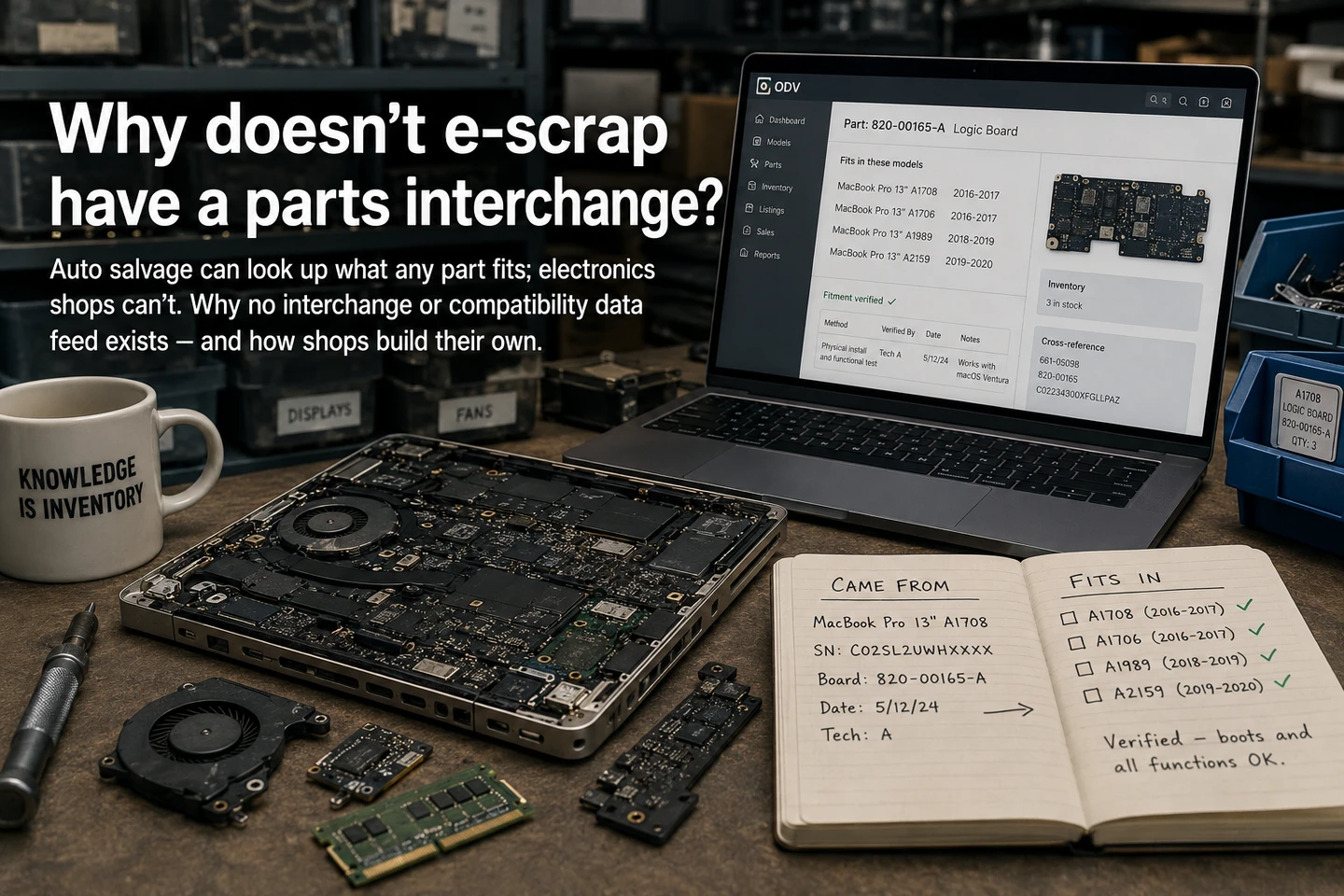
No broadly adopted interchange for used computer parts exists today — no e-scrap equivalent of what the vehicle trades run on. There are substantial catalogs inside individual companies, useful OEM parts diagrams, repair databases, and compatibility tools for selected product lines. What the industry lacks is a shared system comparable to automotive interchange: a common way to identify a recovered part, connect it to every source assembly it fits, show how that fit was verified, and move the data between shops, marketplaces, and repair operations.
The reusable parts exist. The missing pieces are identity, fitment language, verification, and an economic model that pays for the data to be created and maintained. This guide walks through why the gap persists — and what a shop can do without waiting for an industry to close it.
The problem showed up at Part Haven before it had a name
Part Haven — the computer-hardware parts operation the people who built Ordovee run every day — started in 2006 with one dead laptop: a spilled soda, a MacBook Pro, and a repair quote close to the price of a new machine. Replacing it was the economical choice, so the damaged machine went on the bench instead of into a drawer, and its working parts sold for a real share of the replacement’s cost.
That one teardown exposed the basic economics of parts reuse: a device can be uneconomical to repair as a whole while its components still hold real value, because other people need those parts to fix their own machines.
As the operation grew, taking computers apart was never the hard part. The hard part was keeping the knowledge attached to everything that came off:
- What exactly is this part?
- Which machine did it come from?
- Which other machines use it?
- Has that fitment been confirmed, or only inferred from a spec sheet?
- Was it tested? Where is it now? Which listing represents it? Has it already sold somewhere else?
We looked for software built for operations that pull, catalog, stock, and sell parts out of larger units — and found nothing built for the market. So we built it from the shop’s own workflows. That became ODV.
The same problem runs far beyond computer hardware. Electronics, appliances, industrial equipment, agricultural machinery, marine — every trade that turns one unit into many parts faces the same question: how does the knowledge stay attached to each part?
The one industry that solved it
Automotive interchange is not one database; it is a stack. Vehicles carry a shared identity language — year, make, model, trim, engine — standardized well enough that a data company can index against it. On top of that identity sits curated compatibility knowledge: Hollander Interchange indexes millions of parts and their interchangeable equivalents, so a yard can identify a pulled part once and expose it to demand from every compatible vehicle. And the data can move — the ACES and PIES standards give manufacturers, sellers, and marketplaces a machine-readable way to exchange fitment information.
The full anatomy of that stack — and the sharp distinction between a data standard and fitment knowledge — gets its own guide: What automotive interchange actually solved. The short version: auto salvage got an interchange because the industry treated compatibility data as infrastructure, and because the economics of high-volume, stable-identity vehicles could pay for it.
Why electronics never developed one
Every condition that made automotive interchange buildable fails for electronics.
Identity exists — nothing links it. The common description of this problem is that electronics parts are anonymous, and that is not what is happening. They carry numbers, usually several. The brand that sold the machine assigns one. The company that actually built the component assigns another. A second brand shipping the identical part assigns a third. Every one of those numbers is real and in daily use — and there is no public crosslink between them, and no reference that spans brands. A retail model name compounds it, hiding different displays, boards, and batteries across regions, configurations, and silent mid-production revisions.
Fitting and working are different claims. The same component may carry an OEM number, a contract manufacturer’s number, a board number, a superseded number, and a seller’s SKU — some identifying the assembly, others the bare board or a production batch. And “it bolts in” is not “it works correctly”: real fit can turn on pinout, firmware, voltage, or a paired security process. Two screen panels can share a size, a resolution, and a manufacturer and still not interchange, because the connector differs, or the backlight, or where the mounting ears sit.
The catalog is long-tail by default. One inbound unit becomes dozens of distinct parts, many with a quantity of one. Each individual compatibility record is worth little on its own even though the catalog is valuable in aggregate — so no data vendor can cover the territory profitably, and the coverage runs out exactly where the parting-out world begins. Build your own parts catalog walks that gap vertical by vertical.
The economics point the wrong way. The shop doing the teardown pays the labor to identify and verify a part; other sellers, repairers, and buyers capture much of the downstream benefit. Without a way for the shop that creates the data to keep its value, the rational choice is to keep the knowledge private — and that is precisely what the industry does.
And for most of this industry’s life, there was no reason to build any of it. This is the part that gets skipped, and it explains more than the other three combined. Fitment data exists in the vehicle trades because a ten-year-old car has always been worth repairing. A ten-year-old computer was not. Performance moved fast enough that machines went obsolete long before they wore out, and putting good parts into an outdated one was money poured away. Nobody needed to know what fit what, because almost nobody was fixing anything. The infrastructure was not withheld from this industry. It was never called for.
What changed
That has quietly stopped being true, and it is why this question matters now rather than a decade ago. A ten-year-old laptop runs a current operating system. Machines have stopped aging out on schedule, the case for repair came back, and parts hold value in a way they did not twenty years ago — they still lose value on the shelf, but they no longer go to zero the way they once did.
The demand for compatibility data has arrived. What would answer it has not, and the reasons above are why it is unlikely to arrive as an industry-wide system. Which leaves the question of what a shop does in the meantime.
The full cost side — where the missing data actually bites, and a method for measuring it in your own operation — is its own guide: Parts demand depends on fitment data.
What shops do instead
The industry has not waited. It has built local substitutes: technician memory, handwritten notes, private spreadsheets mapping part numbers to models, OEM service manuals, marketplace sold-listing research, photos of labels and board revisions.
Some private systems are substantial. E-Scrap News has reported that ERI — one of the largest e-scrap processors in the country — built an internal catalog covering roughly 40,000 devices, documenting unfamiliar equipment so future units process consistently. SERI reports that R2-certified facilities reused more than 27 million components in 2024.
Recovering components this way is sometimes called demanufacturing — systematically taking a unit apart to recover reusable parts and materials. The physical recovery is only part of the work. Keeping identity, source, test status, compatibility, inventory, and disposition attached to what comes off is the operational layer we mean by Structured Disassembly Management, and it is the layer Ordovee is built to handle.
Component reuse already operates at real scale; what stays fragmented is the compatibility layer. Testing establishes that a part works. Inventory establishes where it is. Neither tells the next buyer what else it fits.
Notice the shape of every one of these answers: each serious operator builds its own documentation layer, privately. That is not a failure of the industry so much as the honest conclusion of its economics — the shop that creates the knowledge keeps it, because the knowledge is a competitive asset.
The interchange you build yourself
That conclusion is the answer to the question in the title, and it is also the practical instruction.
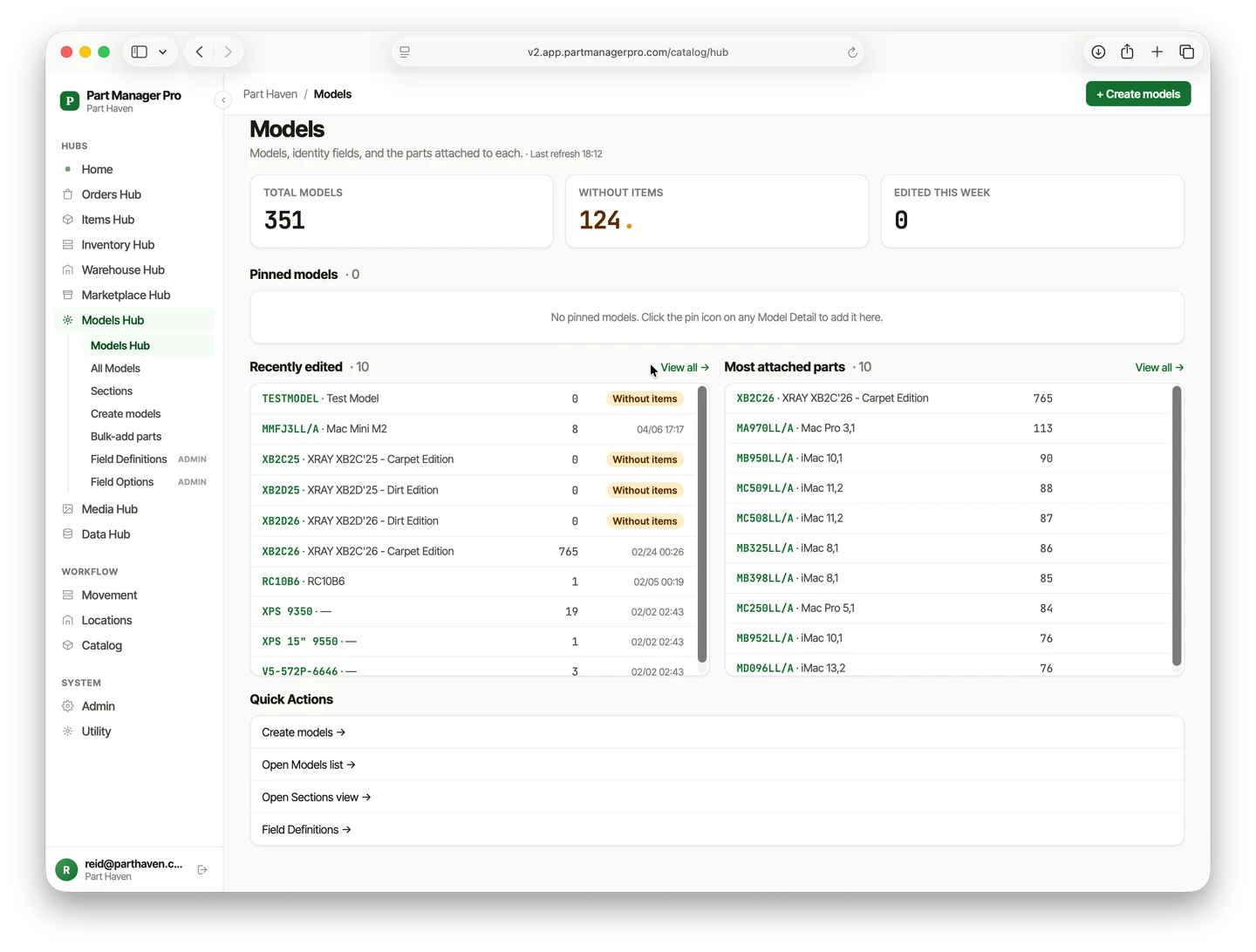
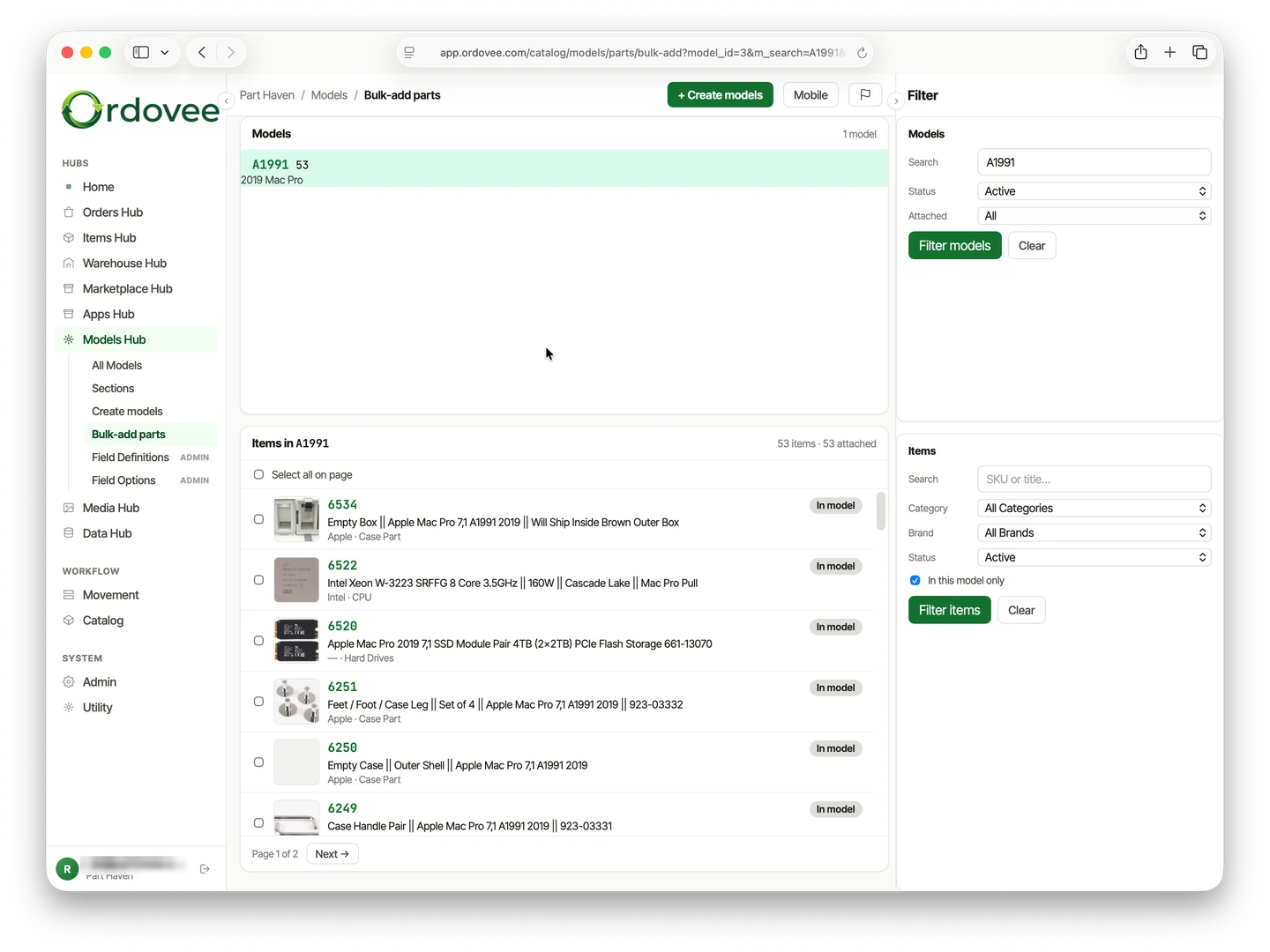
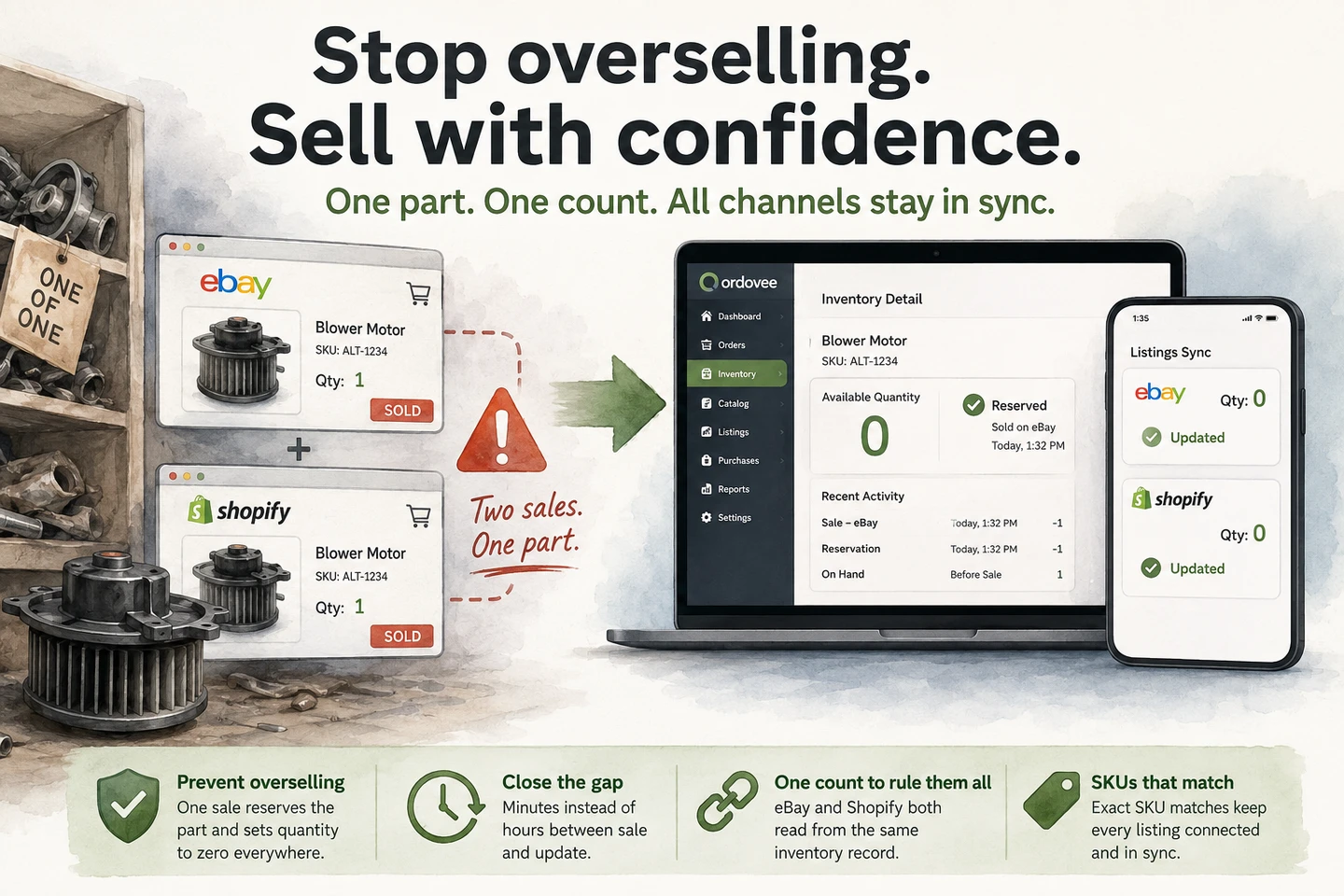
Ordovee is built for exactly this layer. Every unit that crosses the bench gets entered as a model — the source assembly — and every part pulled from it gets attached as it comes off. When experience says a screen panel also fits two other machines, that gets recorded once, at the moment it’s known, instead of remembered. The result is a catalog searchable from both ends: open a part and see every model it fits, open a model and see every part in stock for it — the reverse lookup at teardown time, the forward lookup at selling time. Part Haven runs this daily — thousands of individual components cataloged from MacBooks, iMacs, Mac Minis, and Mac Pros, with quantities kept in step across eBay and Shopify. And the structure doesn’t care what the unit is: a logic board, a washer control module, and a tractor part all describe the same way.
The catalog you build for your business is your record, owned by the account that created it and visible only to that account. Your cross-reference is your competitive asset — the point of writing it down is that it pays your shop back, on every future teardown, listing, and hire.
Whether the industry ever builds a shared interchange is a separate question — an interesting one, with real prerequisites, covered in What a parts interchange would take outside auto salvage. But a shop doesn’t need to wait on it or bet on it. The catalog you build wins on its own: if a shared interchange never comes, you hold the only reliable cross-reference for your shelves; if one someday does, you hold verified records instead of memories.
Common questions
What is a parts interchange?
A parts interchange is a cross-reference that tells you which models share a part. Look up a part and it lists every make, model, and year it fits; look up a vehicle and it lists the parts that interchange with other vehicles. Auto salvage has run on interchange data for generations — it’s how a yard knows what a pulled part fits without testing it against every car ever built.
Is there a parts interchange for electronics?
No. Strong catalogs exist inside individual companies, and OEM diagrams, repair databases, and vertical tools cover slices of the market — but no broadly adopted, shared interchange exists for electronics, appliances, or equipment. Shops that part out these units build their own compatibility records, and Ordovee structures that record at teardown so it becomes searchable data the shop owns.
Can you buy a parts compatibility data feed for electronics?
Not in any usable form. Compatibility data feeds are built where sales volume concentrates — late-model cars and trucks. For used computer parts, appliance boards, and equipment components, the coverage runs out where the parting-out work begins. The reliable cross-reference is the one your own teardowns produce, recorded as you work.
How do e-scrap shops track parts compatibility today?
Mostly in people’s heads, private spreadsheets, and old marketplace listings — which works until the person who holds the knowledge leaves. The durable alternative is recording compatibility in the same system that tracks stock: attach each pulled part to the model it came from and any models you’ve verified it fits, and the cross-reference builds itself as you work.
The question in the title has an honest answer, and it is not that anyone failed. Identity in this industry exists but nothing links it across brands; fitting and working are separate claims; the shop that creates the knowledge has every reason to keep it. Underneath all of that sits the simplest reason of all — for most of the time this industry has existed, almost nobody was repairing a five-year-old machine, so nobody needed the data. That is the part that has changed. The machines last now, the parts hold value now, and the reference that would make them findable still does not exist. The compatibility record in your head is already real. Writing it down where it stays attached to your parts, your listings, and your business is the version that outlasts a memory, a spreadsheet, or an employee.
→ The anatomy of the system auto salvage built: What automotive interchange actually solved → Where the missing data costs you, and how to measure it: Parts demand depends on fitment data → The industry-scale question: What a parts interchange would take outside auto salvage → Start with your own records: Build your own parts catalog · Parts compatibility cross-reference → See how ODV handles the whole part lifecycle: Product overview → Running a parting-out operation? Let’s talk
Sources
- Our Story — Part Haven
- Hollander Interchange — Hollander Solutions
- ERI’s internal catalog covers about 40,000 devices — E-Scrap News
- R2 reuse impact data — SERI
See Ordovee in your operation.
The fastest way to know if ODV fits your shop is to see the workflow with your own data — no slides, no scripted demo.