“I picked all those orders — why aren’t they showing?”
We use Ordovee to run Part Haven, our own parts shop. We started building ODV because what we had wasn’t cutting it, and we still use it every day — same workflows, same handhelds, same desktop screens as the shops we sell to. When something goes sideways, we feel it first.
Last week our picker came off the warehouse floor with a question that every shop owner has heard some version of: she’d been scanning orders through the handheld all morning, but the desktop fulfillment screen still showed them as Ready to Pick. Were they picked or weren’t they?
The old way to answer that — before any real system — is a shrug and an hour of poking around. We pulled it up in twenty minutes, and most of that was conversation with the picker. The records did the heavy lifting.
Step 1: Pull up the picker’s session
Ordovee records every pick session as its own row — who started it, when, what state it’s in, how many orders are inside it, how many of those have been confirmed picked. We opened the picker’s recent sessions and there it was: one session, still open, started that morning. Thirteen orders in it, eleven marked complete, two not.
That was the first useful clue. The session hadn’t been closed. We didn’t know why yet, but we knew exactly where to look.
Step 2: Walk through the orders inside the session
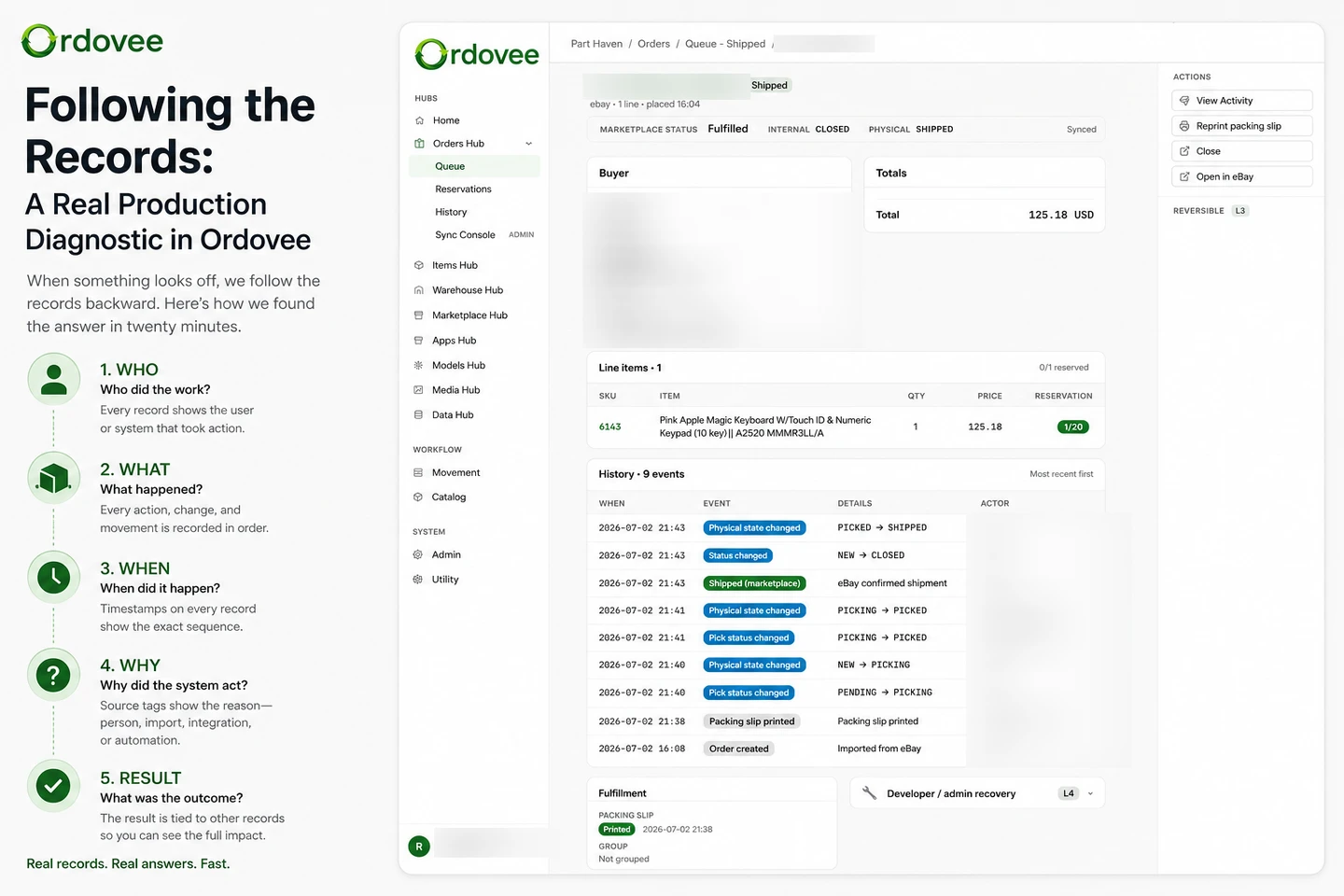
Each order in a session has its own activity trail. Open the session and you see every order’s outcome side-by-side — confirmed picks with timestamps, bins, quantities, and the picker’s name on each one. Eleven orders had a full chain of confirmed pick activity. Two had none.
The two with no activity were both for the same item — a specific keyboard model. That matched something the picker mentioned. She’d been waiting on those particular keyboards to come back to the shelf from a return-to-stock job and hadn’t been able to grab them yet. Two orders, same shelf-not-yet-restocked situation.
So far, every record matched what the picker remembered. The data was telling us the truth.
Step 3: Confirm the picks that did happen actually landed
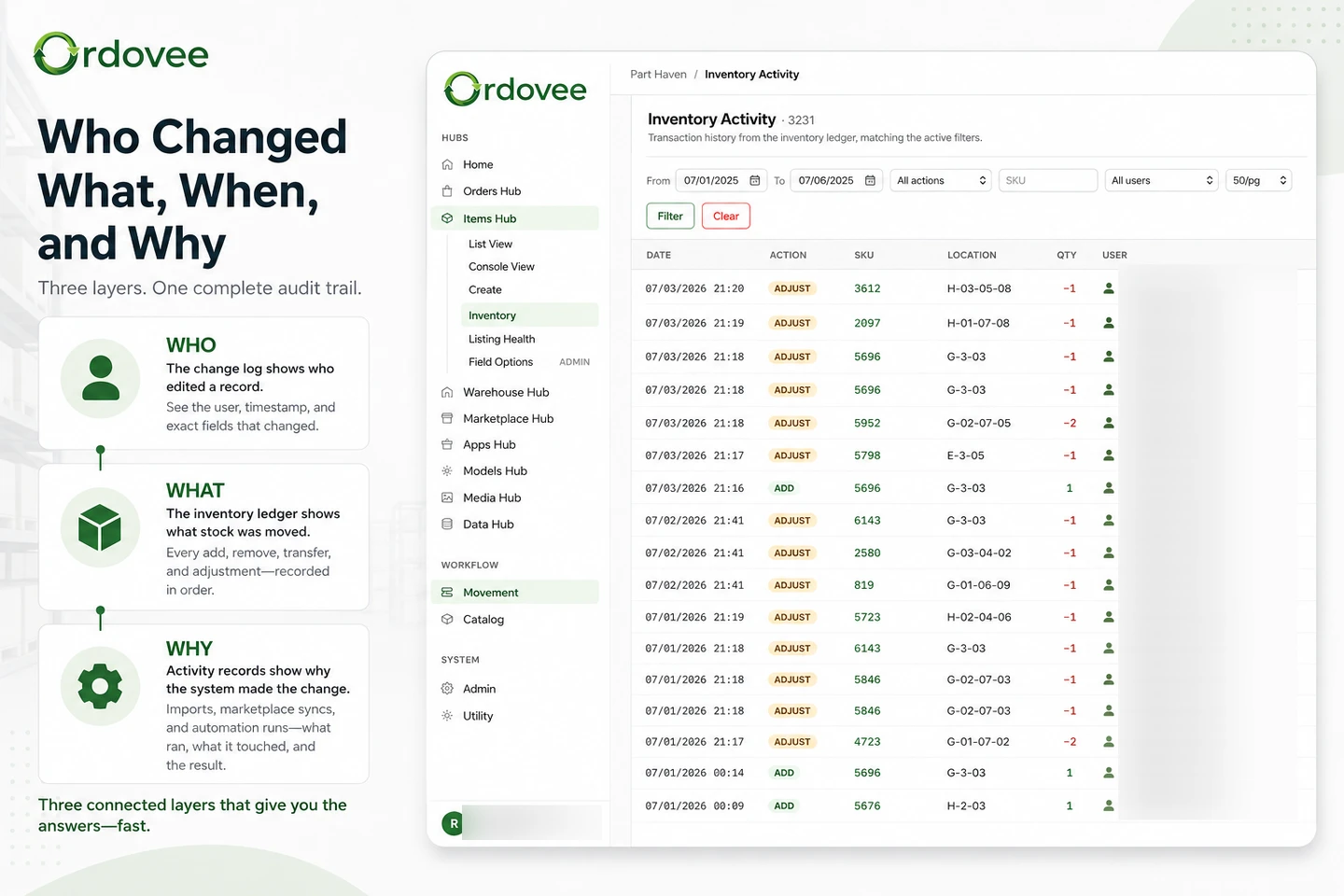
For the eleven orders that had been picked, the inventory ledger showed each pick as its own line — bin, quantity, timestamp, the picker’s name on every row. The on-hand counts had dropped accordingly. The marketplace quantity push had already run with the updated numbers.
This is the part that matters. It meant nothing was lost. The picks had landed. The records were honest. No customer was going to be told a part was in stock when it wasn’t, and our own reorder math wasn’t being thrown off.
Want to see how Ordovee records picks the moment they happen? → Walk through scanner-first picking
Step 4: The diagnosis
Here’s what the records added up to: the picks were complete, the eleven orders were marked done inside the session, but the orders themselves hadn’t surfaced as “Picked” yet on the desktop. The reason was the session itself — still open, still waiting on those last two keyboards to resolve one way or another.
The picker had set the keyboards aside to come back to later. Perfectly reasonable thing to do in a real shop — parts move, shelves get restocked, you finish what you can and circle back. The records reflected exactly that: eleven picks done and recorded, two deferred. What the system hadn’t yet learned to do was surface the eleven completed orders for the next stage of fulfillment while the picker was still working on the two open ones.
That’s the gap. The records were honest about what had happened. We just hadn’t taught the desktop to read them the way the picker meant them.
Step 5: The fix
In about twenty minutes of looking at records — no guesswork, no “let me ask the picker again tomorrow,” no chasing people over chat — we knew:
- Exactly which orders had been picked (the eleven with full ledger entries attached)
- Exactly which two were blocked (the keyboards, no pick activity, picker confirmed why)
- Exactly why those eleven weren’t visible yet (session still open, waiting on the other two)
- Exactly what to change so the same thing can’t get hidden the same way again
We’re rolling out that change now. The bigger point isn’t the fix — it’s that the diagnosis was fast because every action had already been written down by name, with a timestamp, with a source. There was nothing to reconstruct from memory.
What a real audit trail gives you
A real audit trail does more than say this changed. It says what changed, who changed it, when, and from what value to what value. It links related changes — a stock movement to an order, an order to a session, a session to a picker. Every entry carries a source tag so you can tell whether a person did the work, an import did, an integration did, or an automated process did.
That’s the difference between an audit trail that’s a footnote and an audit trail you can actually diagnose with. Ordovee writes these records as your team works, not as an afterthought. When something feels off, you open the records and walk backwards until reality and the records stop matching. That’s where the truth lives.
Most days you never look. The week you need to look, the records are already there.
What you get
If you’re running on spreadsheets right now, you know this kind of problem from the other side: something is off, nobody remembers, you cross-reference dashboards and message threads, and the answer arrives a day late and a part short. With Ordovee’s records the same question takes the time it takes to make a coffee.
We aren’t telling you this story because ODV is perfect — we’re telling you because we use it every day in a real shop, and when our own picker hit a real edge case, the records caught it. That’s the bar.
→ See how the records fit together: Who Changed What, When, and Why → Want to walk a real diagnostic with your own inventory? Trace a Change in ODV | See the Full Feature Set
See Ordovee in your operation.
The fastest way to know if ODV fits your shop is to see the workflow with your own data — no slides, no scripted demo.