The once-a-year shutdown nobody looks forward to
For a lot of parts operations, “counting inventory” means one thing: a physical inventory — the once- or twice-a-year event where you stop the floor, hand everyone a clipboard, and count 100% of your stock against the records. It’s also called a full count or a wall-to-wall count, and it works. It also costs you a day (or a week) of production and overtime — and the accuracy starts drifting back the moment the lights go back on.
There’s a better-known alternative, and it’s what modern warehouses run instead: cycle counting — checking a small batch of stock on a rotating schedule, without ever shutting the floor down. This guide covers the difference between a physical inventory and a cycle count, the two kinds of cycle count Ordovee gives you, and how to decide which to run when.
What a physical inventory actually costs
A physical inventory count is thorough — every location, every SKU, all at once. That’s its appeal and its problem:
- The floor stops. You can’t pick a shelf and count it at the same time, so most operations pause receiving and fulfillment while the count runs.
- It’s a snapshot, not a habit. The day after a wall-to-wall count, your numbers are perfect. A month later, drift has crept back — a part in the wrong location, a miscount at receiving, a pull that never got logged — and you won’t catch it until the next annual count.
- Errors hide in the gap. Between counts, an oversell or a missed pick traces back to a number that went wrong months ago, with no record of when.
What is inventory drift? Drift is the gap that opens between your recorded count and what’s actually on the shelf, built up from small unlogged changes between counts.
The problem was never counting. It’s that counting everything at once, rarely, leaves long stretches where you’re trusting numbers you haven’t verified.
Cycle counting: the same accuracy, spread out
Cycle counting turns one big disruptive event into a steady, small routine. Instead of counting everything once a year, you count a batch of locations every day or every week — and over a few weeks you’ve covered the whole warehouse, without ever stopping the floor.
Two things make cycle counting work as a system of record instead of a periodic scramble:
- A perpetual record. Ordovee tracks every add, removal, transfer, and adjustment in a permanent ledger, so your counts stay current continuously — a count sheet checks reality against a live number, not a number from last quarter.
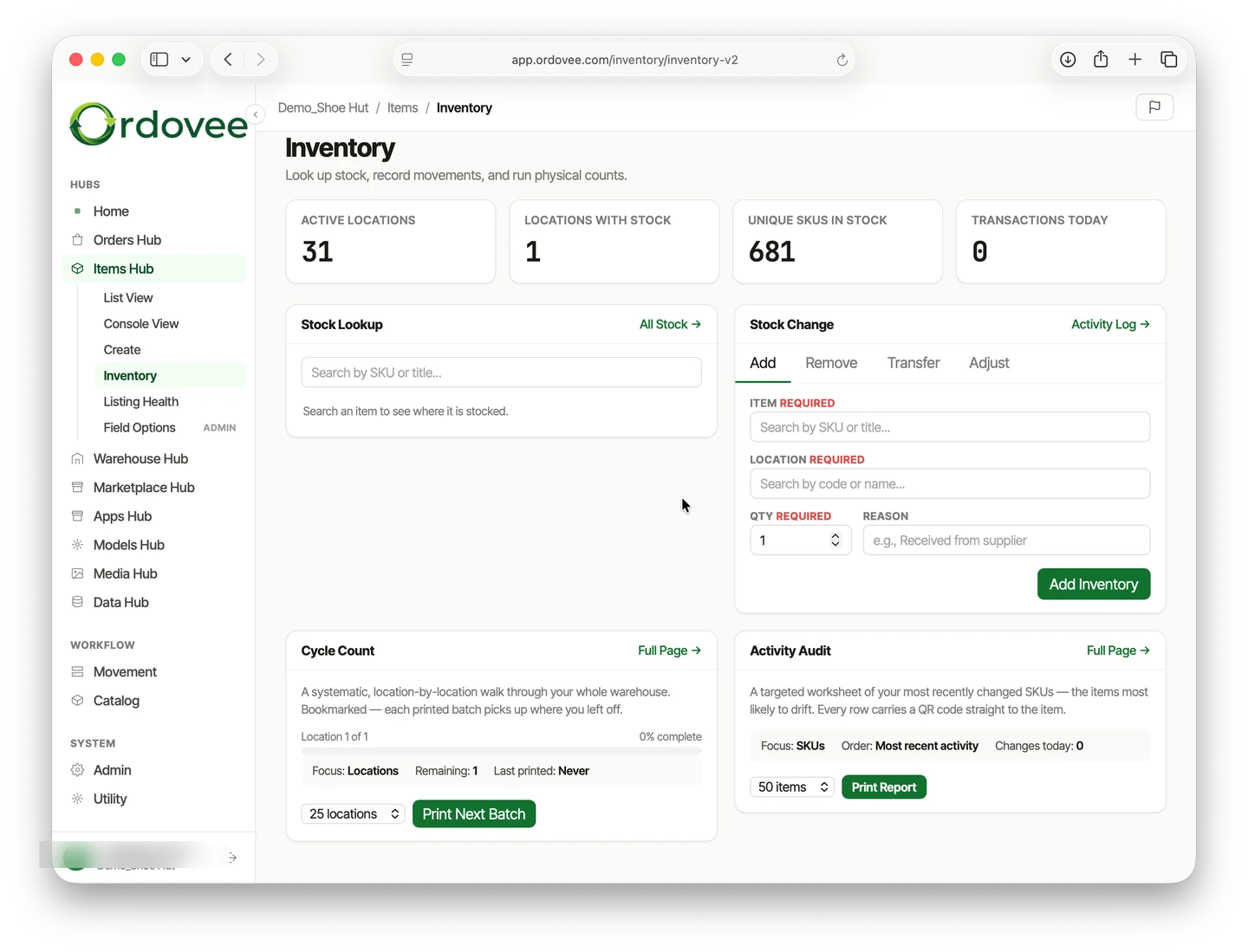
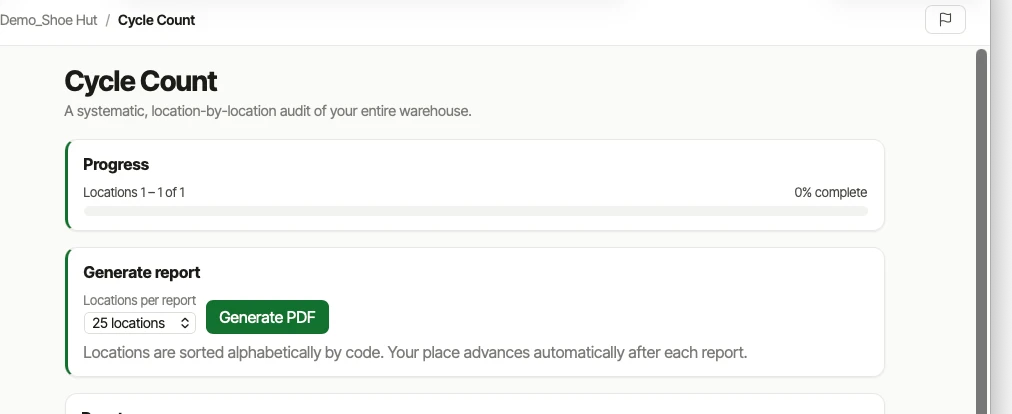
- Coverage that remembers itself. ODV’s cycle count remembers where the last count sheet ended, so “count the whole warehouse” becomes “count 25 locations today” without anyone keeping track of which locations come next. That presumes the locations exist and are labelled; if yours are not, organizing a warehouse one shelf at a time is the place to start.
Run a full cycle count through every location and you’ve reached the same complete coverage as a physical inventory — a rolling wall-to-wall count — with none of the shutdown.
Two ways to count — and when to use each
Cycle counting isn’t a single method. Ordovee builds in the two that matter most for a parts operation — one for full coverage, one for the parts that moved most recently.
Cycle Count — when you need full coverage
Reach for the Cycle Count when the goal is everything, eventually: a standing warehouse audit, verifying every location after a big reorganization, or covering the whole floor before a quarterly deadline. It walks every location that has held stock, in order, and bookmarks your place, so complete coverage happens a batch at a time — your rolling physical inventory, without the shutdown. Walk through it →
High-Turn Check — when you need it now
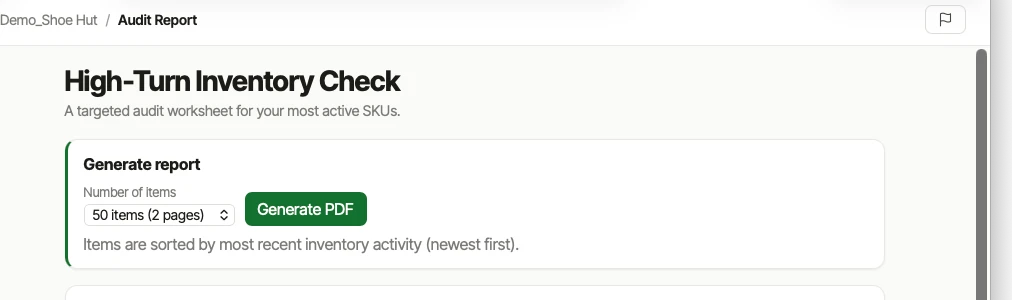
Reach for the High-Turn check when you can’t wait for the full sweep to come around: a daily spot-check at shift start, a sanity pass after a busy receiving or order rush, or a quick audit when a pick comes up short. In the industry this is usage-based cycle counting (a.k.a. high-touch counting) — verify the parts that move most, because that’s where a count drifts fastest. We’ve decided to call it the High-Turn Inventory Check in ODV. One difference: instead of ranking parts by how much they have moved, it lists the parts with the most recent inventory activity first. Walk through it →
How often should you cycle count?
There’s no single number — it tracks how much moves. A practical rhythm for a parts shop: a 25-location cycle count every weekday, so the whole warehouse is covered in a month or two, plus a weekly high-turn check on the most recently active SKUs. Count the fast movers more often than quiet stock — that’s where a count drifts fastest.
Which one should you run?
Short version: run both, on different cadences — they answer different questions.
| Physical inventory | Cycle Count | High-Turn Check (usage-based) | |
|---|---|---|---|
| Scope | Everything, at once | Every location, in rolling batches | The most-recently-active SKUs |
| Disruption | Floor stops | None | None |
| Cadence | Once or twice a year | A batch every day or week | A weekly spot-check |
| Best for | The old way — what Ordovee replaces | Full, ongoing coverage | Quick spot-checks between full sweeps |
A practical rhythm: a 25-location Cycle Count every weekday (the whole warehouse covered in a month or two) plus a 25-item High-Turn Inventory Check once a week. Continuous coverage, plus a recurring check on the most recently active SKUs — and no annual shutdown.
What to do when a count doesn’t match
Every count report eventually turns up a mismatch. That’s the point — you’d rather find it on a count sheet than in a customer’s cancelled order. Ordovee handles the correction through the same tools you use every day:
- Small corrections. Open the item by the SKU printed on the sheet, use the ADJUST action, enter the difference from the expected quantity (two short is −2), and give a reason. The correction writes to the ledger with the user, timestamp, and reason recorded.
- Pattern errors. If the same SKU keeps turning up in the wrong location, the count isn’t the problem — the location assignment or the label is. Fix the root cause and the drift stops coming back.
- Missing items. If a location is empty that shouldn’t be, ADJUST takes it to zero with a reason. The reservation and order flow pick up the change, so nothing gets promised that’s no longer on hand.
Every adjustment lives in the ledger permanently — so a month later you can see exactly when a count was corrected, who corrected it, and why.
The verification that keeps everything else honest
Counts don’t sell parts or ship orders. They’re the quiet verification work that keeps every other system honest — because picking, the order lifecycle, and marketplace sync all depend on the numbers being right in the first place. The difference between a physical inventory and cycle counting isn’t accuracy; it’s whether you earn that accuracy once a year with a shutdown, or continuously without one.
→ Walk the full-warehouse method: Cycle Counting in Ordovee → Spot-check the movers: Usage-based cycle counting, the High-Turn way → See how counts tie back to the record: Ledger-based inventory → Want this dialed in for your shop? Let’s talk
See Ordovee in your operation.
The fastest way to know if Ordovee fits your shop is to see the workflow with your own data — no slides, no scripted demo.