A rolling count that never stops the warehouse
The old way to verify inventory is a physical inventory — stop the floor once a year and count everything at once. Cycle counting is the alternative: check a small batch of locations at a time, on a rotating schedule, until the whole warehouse is covered — without ever pausing receiving or fulfillment. Run it through every location and you’ve reached the same complete coverage as a physical inventory, just spread out and non-disruptive. (For the full comparison, see physical inventory vs. cycle count.)
Ordovee’s Cycle Count is the location-first half of that routine. Here’s how it works. (It assumes your locations are labelled and their contents recorded — if that is still ahead of you, start with one shelf rather than the whole warehouse.)
How Ordovee runs it
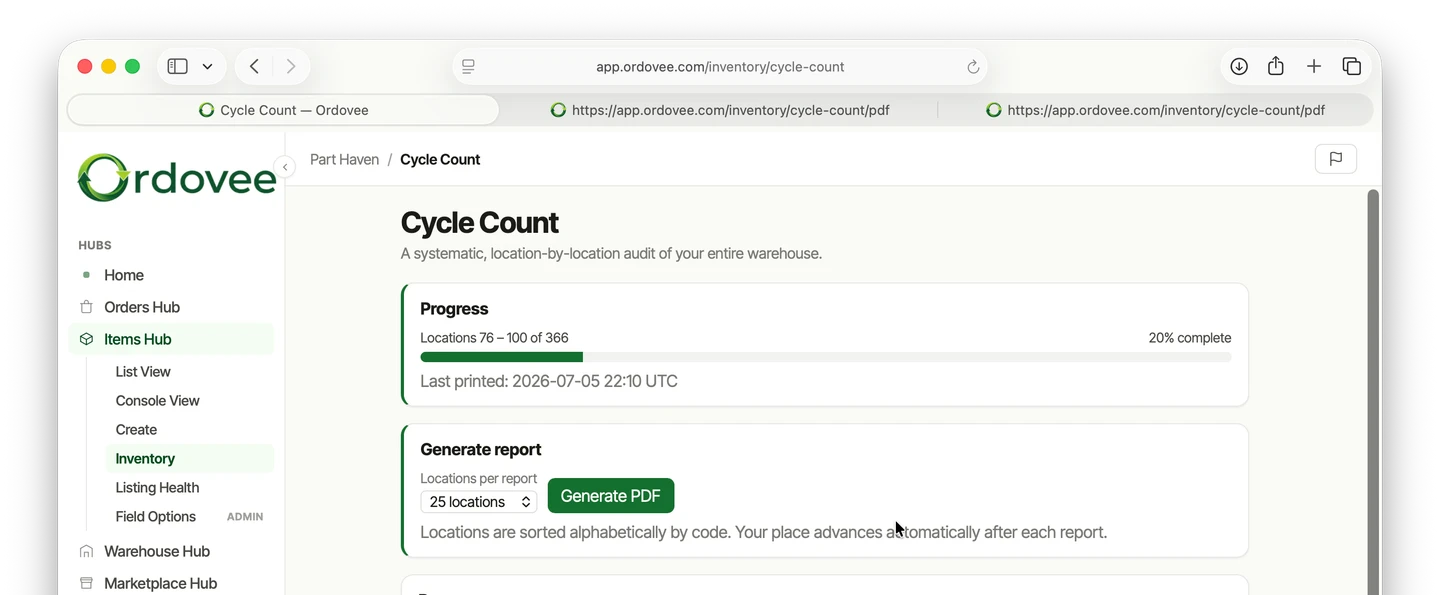
Open the Cycle Count page and choose how many locations you want on one report — 25 is the default, which usually gives one counter about 30–45 minutes of counting.
Tap Generate PDF. ODV prints a report organized by location code, in alphabetical order, so your counter walks a logical path through the warehouse. Each location shows every SKU there, the expected quantity, and a blank line for the counted quantity.
Empty locations are included too — with a note to confirm the bin is actually empty. That’s intentional. An empty bin that shouldn’t be empty is just as important to catch as a bin with the wrong count.
The bookmark
This is what makes cycle counting sustainable. Ordovee remembers where you left off.
The next time you generate a report, it starts at the next location — so the first report covers locations 1–25, the second covers 26–50, and so on. The progress bar on the page shows how far you are through the warehouse and when you last printed. Run one report a day and you can work through the full warehouse in a few weeks, without anyone having to remember where the last count stopped.
If you ever need to start over — after a major reorganization, for example — there’s a reset button that sends the bookmark back to the beginning.
How many locations should you count in a day?
Default to 25 locations per report — about 30–45 minutes for one counter. To size it to your warehouse, divide your total locations by the number of workdays you want a full sweep to take: 500 locations over 20 workdays is 25 a day.
How to do a cycle count, step by step
- Pick a batch size — 25 locations is the default.
- Generate the count sheet; the locations come out in walk order.
- Count each bin against the expected quantity on the sheet.
- ADJUST any mismatch with a reason — the correction writes to the ledger with your name and a timestamp.
- The bookmark advances, so the next report starts exactly where you stopped.
What does the count sheet look like?
Each page is a clean, printable list. Locations are numbered (#1, #2, #3…) so your counter can track progress at a glance. Every location shows its code, the site name in parentheses, and either the SKUs expected there or a note that it should be empty.
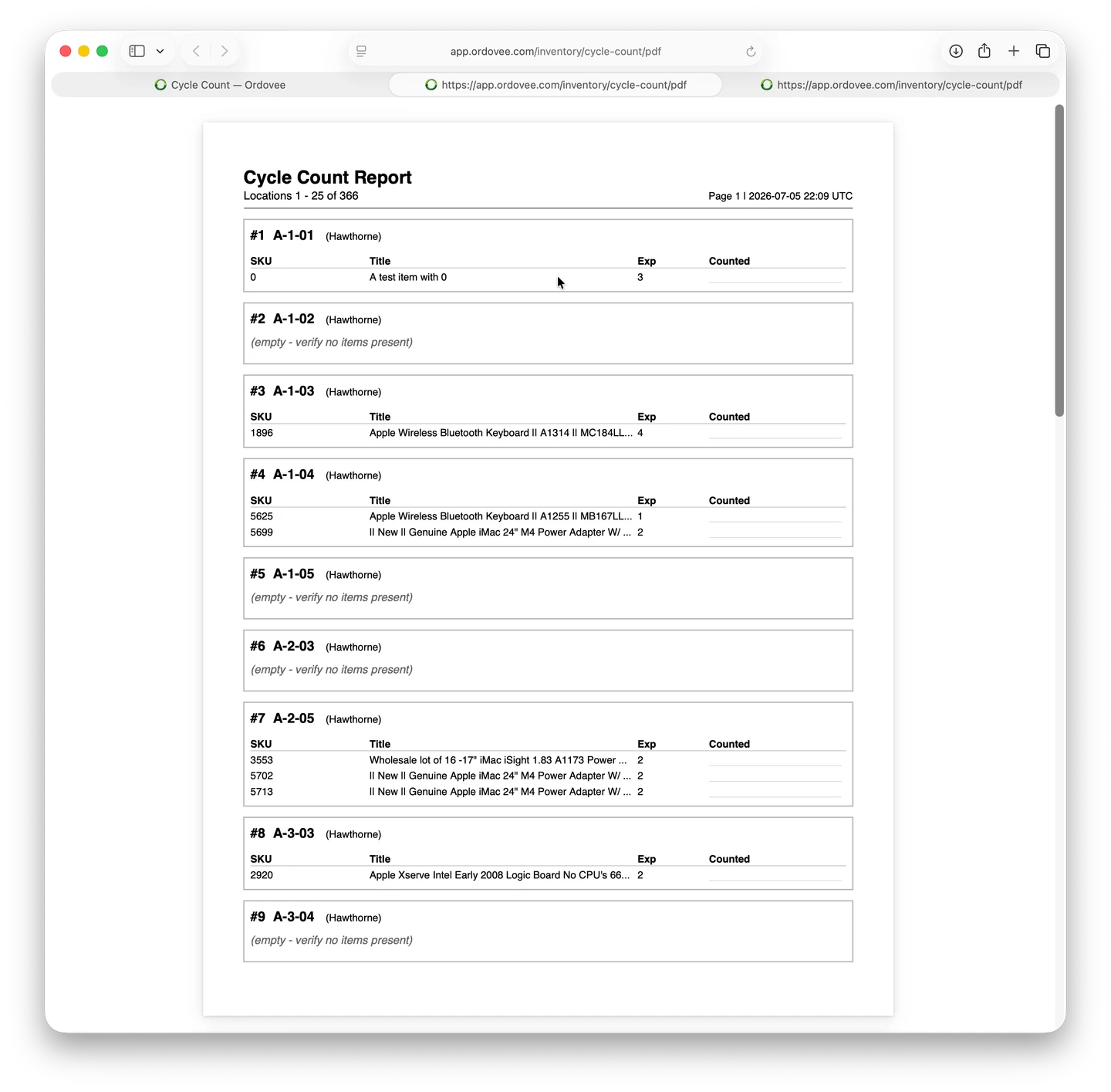
Found a mismatch? Open the item (scan the QR code from the sheet), use the ADJUST action, enter the real quantity, and give a reason. The correction writes to the ledger with the user, timestamp, and reason recorded — so a month later you can see exactly when a count was corrected and why.
A few tips from the floor
- Print, don’t tablet. Most counters move faster with a clipboard and a pen. PDFs are the format for a reason — hands free for pulling parts, eyes on the shelf instead of a screen.
- QR codes save time. When a count is off, scan the code on the sheet to jump straight to the item page. Faster than typing a SKU.
- One counter per report. Hand-offs between counters mid-report cause more errors than they save time. Finish the page, then rotate.
- Count at the start of the day. Receiving hasn’t happened yet, picking hasn’t disturbed the shelves, and your numbers are as stable as they’ll be all day.
The quiet work that keeps everything else working
Cycle counts don’t sell parts. They don’t ship orders. They don’t push quantities to eBay. They’re the verification work that keeps every other system honest — because the picking workflow, the order lifecycle, and the marketplace sync all depend on the counts being right in the first place.
Ordovee’s job is to make that verification easy enough to become routine. One button. One printed sheet. One scan per adjustment. A bookmark that remembers where you left off so nobody has to.
→ Don’t want to wait for a full sweep to reach your fast movers? Usage-based cycle counting — the High-Turn Check → Weighing it against the annual count? Physical Inventory vs. Cycle Count → See how picking uses these counts in practice: Scanner-First Picking → Want to see how Cycle Count fits into your shop? Let’s talk
See Ordovee in your operation.
The fastest way to know if ODV fits your shop is to see the workflow with your own data — no slides, no scripted demo.