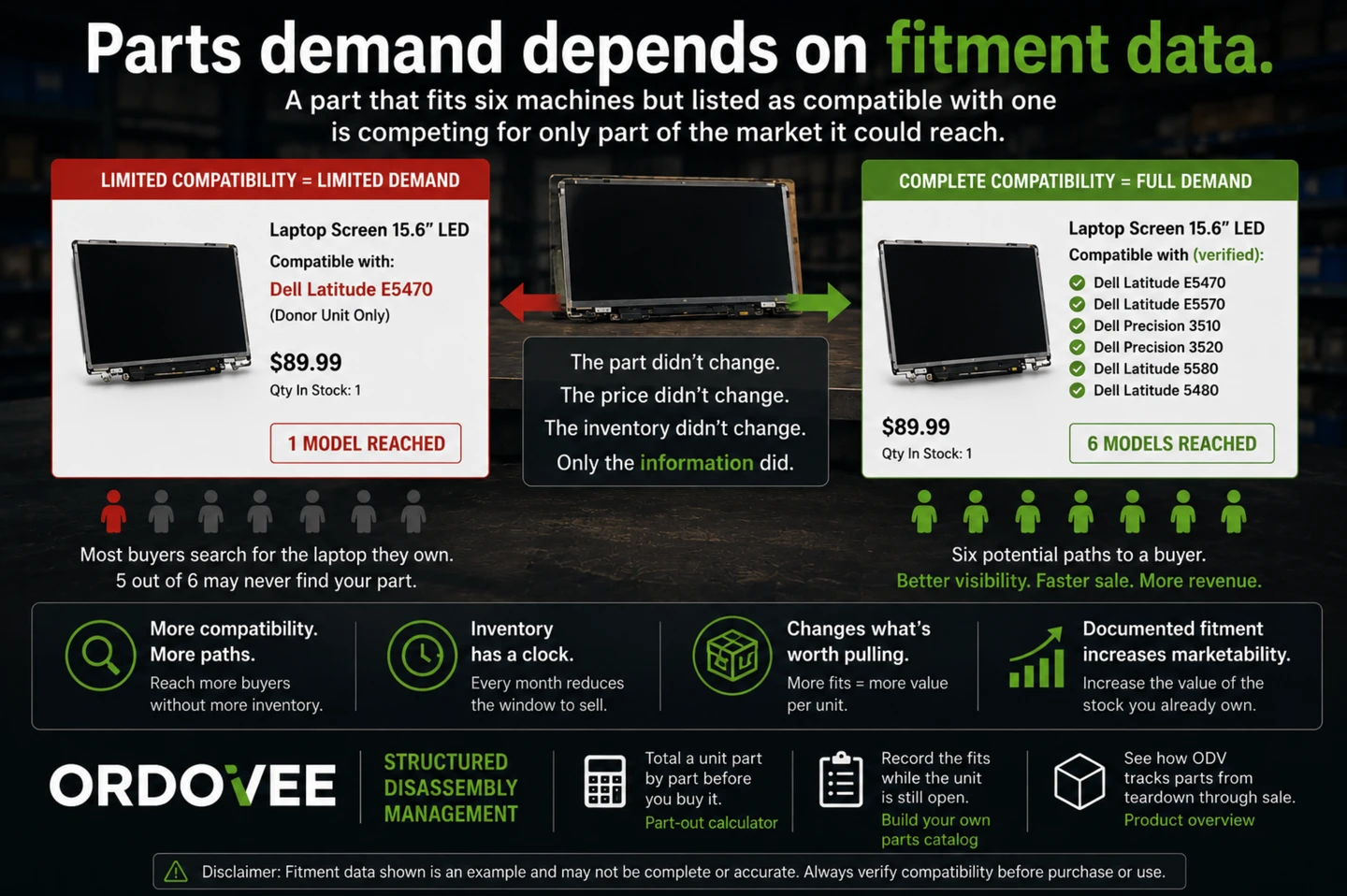
A part that fits six machines but is listed as compatible with one is competing for only part of the market it could reach.
The part did not change. The price did not change. The inventory did not change.
Only the information did.
That screen has been sitting on the shelf since spring. The price is reasonable. The listing looks fine. But it names only the laptop it came out of, even though the same screen fits five other models.
A buyer usually does not search for a laptop screen. They search for the laptop they own.
If your listing names only the donor unit, buyers searching for the other compatible models may never find your part.
That is what missing compatibility data costs.
The physical compatibility already exists. Recording it determines how much of that existing market you can actually reach.
Compatibility does not create demand. It lets your inventory participate in more of the demand that is already there.
And unlike buying more inventory or spending more on advertising, documenting compatibility can increase the marketability of stock you already own.
Why nobody simply hands used-parts businesses a complete interchange is a separate problem. We cover that in Why don’t used computer parts have an interchange?
This is about what compatibility information is worth once you have it.
What six compatible machines actually change
A laptop screen that fits six machines is not automatically worth six times as much as one that fits a single machine.
The price may not change at all.
What changes is the number of legitimate paths that can lead a buyer to that part.
If a screen fits six laptop models, there are potentially six groups of owners who may need it. Those groups are not necessarily equal. One model may be common, another rare. One may still have strong repair demand while another has largely aged out of service.
You usually do not know which application will produce the eventual buyer.
That is exactly why recording all confirmed applications matters.
More compatibility gives the part access to a larger addressable market. In practice, that can affect two numbers that matter far more than theoretical listing value: how quickly the part sells, and whether it sells at all before its useful market disappears.
Inventory has a clock.
A control board, display, motor, valve, or screen can sit on a shelf for years while the machines it serves slowly leave service. Every month that passes reduces the remaining window in which somebody still needs it badly enough to buy it.
The same physical part can therefore have very different sales outcomes depending on how much of its compatibility is known and represented.
List it under one machine and you expose it to one portion of its potential market.
Document six confirmed applications and you give it six possible routes to a buyer.
Compatibility changes what is worth pulling
The value of compatibility starts before the part ever reaches a shelf.
Two components come off the same unit.
Both take the same amount of time to remove. Both need to be tested, labeled, photographed, entered into inventory, listed, stored, and eventually shipped.
One is known to fit only the machine it came from.
The other is confirmed to fit six different machines.
Those are not necessarily equally attractive parts to harvest.
A component with one known application has to justify all of the labor and storage required to turn it into saleable inventory. Many perfectly usable parts never clear that threshold.
They stay on the unit and eventually move downstream for material recovery.
But the identical removal effort can make much more sense when the part serves several active applications.
The part did not change.
The expected recovery value did.
That difference affects what gets pulled from every unit that crosses the bench.
It also affects what the source unit itself is worth.
Two buyers can look at the same pallet of equipment and see completely different economics. One sees the obvious parts tied to the machines sitting in front of them. The other knows that several boards, displays, motors, or assemblies inside those machines also serve other models.
They are not valuing the same opportunity.
That is why fitment belongs in the teardown economics, not just in the final listing.
The part-out calculator lets you total a unit part by part before committing to it. Compatibility is often what determines whether some of those rows belong in the calculation at all.
Missing compatibility gets paid for more than once
Reduced search exposure is only one cost.
The other cost is repeatedly rediscovering information the business already learned.
A technician identifies a board in March and works out that it fits four machines. The information stays in a browser tab, a notebook, or the technician’s memory.
Six months later another copy of the same board comes across the bench.
Nobody can find the first answer.
So somebody spends another twenty minutes working it out again.
The business has now paid twice for the same knowledge.
That pattern scales quickly across hundreds or thousands of parts.
Then there is the staging pile.
Most shops have one.
Parts were removed with good intentions but never received a complete identity, location, test record, or compatibility record. They physically exist, but operationally they are difficult to find, difficult to list, and difficult to trust.
The worst version of missing compatibility data is not an incomplete listing.
It is inventory that never becomes properly saleable because the information needed to describe it was never captured between the bench and the shelf.
The cheapest time to capture that information was when the machine was still open.
An hour later, it becomes research.
A week later, it may become a guess.
Six months later, somebody may have to solve the same problem from scratch.
Compatibility is only valuable when it is correct
There is an important distinction between possible fitment and confirmed fitment.
More model names are not automatically better.
Ten copied guesses are worse than three applications somebody actually verified.
Bad fitment data creates its own costs: wrong orders, returns, freight in both directions, customer frustration, and eventually a catalog nobody trusts.
Marketplace listings can help identify possible applications, but they should be treated as research leads rather than proof.
A stronger verification order is:
- Manufacturer or service documentation.
- Matching OEM or manufacturer part numbers.
- Previous teardown records.
- Technician-confirmed physical fitment or interchange.
- Marketplace listings used to identify additional applications that still need verification.
The goal is not to build the longest fitment list.
The goal is to build a fitment record you are willing to reuse.
That distinction matters because a verified fit becomes an asset.
The next time that same part appears, the research is already done.
The next employee does not have to know what the senior technician knows.
And the next listing does not start from zero.
Count the gap on one part this afternoon
You do not need a major catalog project to see whether this matters.
Pick one slow-moving part from your shelf.
Ideally, choose something that has been sitting long enough to annoy you.
First, identify every application you can reasonably confirm for that part.
Use the part number, service documentation, previous teardown records, technician knowledge, and marketplace research to build the list.
Then look at how the part is represented today.
How many of those confirmed applications are actually attached to the record or represented in the listing?
Now calculate:
Compatibility Coverage = Represented Confirmed Applications ÷ Total Confirmed Applications
Suppose you confirm that a control board fits eight machine models.
Your current listing mentions two.
Your compatibility coverage is:
2 ÷ 8 = 25%
That does not mean sales will automatically quadruple if you add the other six models.
It means something simpler and more defensible: your current listing represents only one quarter of the compatibility information you have confirmed.
Six known applications are currently absent.
Those are six additional ways a legitimate buyer might identify your part as the one they need.
Update the listing.
Then repeat the exercise on another slow-moving item.
You will know very quickly whether your catalog has a compatibility problem.
Where the compatibility record should live
The biggest mistake is treating compatibility research as something that happens later, when somebody finally gets around to listing the part.
By then the best evidence is already disappearing.
At teardown, the donor unit is still open. Labels are visible. Connectors, mounting points, surrounding assemblies, model numbers, and related parts are physically in front of the technician.
That is the cheapest moment to preserve what the shop has learned.
The catalog in Ordovee is built around that idea.
The unit enters the system as a source assembly. Parts are attached to that source as they come off, and fitment can be recorded as it is confirmed instead of reconstructed weeks later as a separate cataloging project.
When the same model arrives again, the shop is no longer starting from nothing.
When the same part appears again, the known applications are already there.
When it is time to create a listing, the operator is reusing an answer rather than reopening the research.
And the pattern is not specific to computers.
A laptop display, appliance control board, hydraulic component, HVAC motor, or equipment module all present the same underlying problem: one physical part can serve multiple machines, and the value of knowing those relationships compounds every time the part appears again.
Compatibility records in ODV belong to the shop that creates them. Whether the industry could ever build something shared is a genuine question with real prerequisites — what a parts interchange would take outside auto salvage walks the ten of them.
That matters because the business that spends the time confirming those relationships should retain the value of that work — across future teardowns, listings, purchases, and employees.
What a part came out of is provenance.
What it fits defines its potential market.
The part already has those applications whether your catalog knows about them or not.
The revenue question is how many of them you can identify, verify, preserve, and put in front of the next buyer.
→ Why nobody hands you the fits: Why don’t used computer parts have an interchange? → Total a unit part by part before you buy it: Part-out calculator → Record the fits while the unit is still open: Build your own parts catalog → See how ODV tracks parts from teardown through sale: Product overview → Want a second read on your workflow? Let’s talk
Sources
- Global E-waste Monitor 2024 — UNITAR
- R2 reuse impact data — SERI
- Hardware demand puts new focus on parts harvesting — E-Scrap News
See Ordovee in your operation.
The fastest way to know if ODV fits your shop is to see the workflow with your own data — no slides, no scripted demo.