Pull a part off a dead machine and you know one model it fits, because you watched it come out. Outside auto salvage that is the whole reference — one part, one model, and no way to tell whether there are ten more. Everything else it fits is a guess, or something in one person’s head. Neither is a record.
Auto salvage works the other way round. A yard doesn’t work out what a part fits — it buys the answer. Commercial services have spent decades compiling which part numbers go with which vehicles, they keep that current, and yards pay to look it up. Pull an alternator, enter the number, and the service returns every vehicle it was fitted to. That bought reference is an interchange. No yard built it; every yard subscribes to it. The software a yard runs is built around that subscription — a yard management system, where the interchange number is the spine every other record hangs from.
So why did one trade get a shared reference and the rest didn’t? Not because the goods weren’t worth fixing. A washing machine always was. So was a tractor, a compressor, an outboard.
Vehicles got one because vehicles are a single trade. Every yard, every repairer and every insurer needed the same answers about the same cars, so a company could compile that reference once, sell it to all of them, and go on selling it for decades. There was a market for it.
Everywhere else the customers are scattered. A shop parting out washers, a yard cutting up combines and an outfit stripping laptops have the same problem and nothing else in common — not the machines, not the part numbers, not the buyers. No one product serves all three, so nobody built one.
What changed is not what the parts are worth. It is what it costs to keep a record of them. Structured data, barcode scanning, a catalog you can search from either end — that used to arrive as part of a big system, with staff employed to run it. It was priced for a scale of business most parts operations never reach, whatever the parts themselves were worth.
Those same tools are within reach of a small operation now. Scanning, a structured catalog, a record searchable from either end — a shop can run all of it without an IT department or a system priced for a corporation. That is what makes the question worth asking now rather than twenty years ago.
So if somebody did set out to build an interchange for everything else — a parts compatibility data feed any shop could query, whatever it takes apart — what would it actually take?
Why a compatibility record needs a type
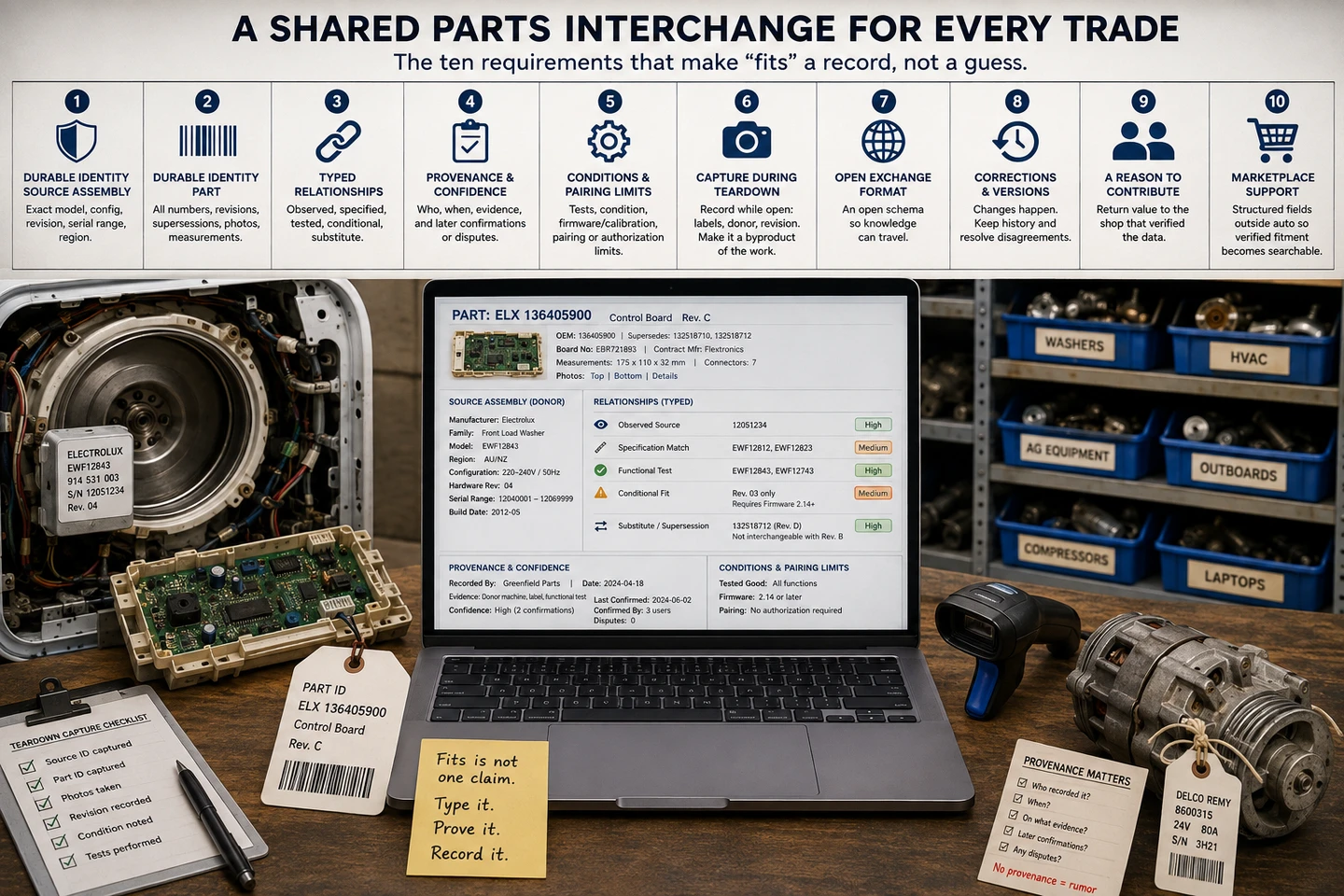
The core design problem is that parts interchangeability is not one claim. “Fits” covers at least five different relationships, and a useful record has to tell them apart:
- Observed source — this exact part was pulled from this exact source assembly.
- Specification match — dimensions and published specs appear compatible; nobody has proven it.
- Functional test — the part was installed or tested successfully in the target assembly.
- Conditional fit — works only with a certain revision, cable, firmware level, or configuration.
- Substitute / supersession — a different part number replaces the original, with known limits.
A spreadsheet cell that says “fits several Dell models” collapses all five into one untyped claim — which is exactly why spreadsheets produce wrong-fit returns. The confidence level is the data.
The ten requirements
1. Durable identity for the source assembly. Manufacturer, family, exact model, region, configuration, hardware revision, relevant serial range — specific enough to explain why two visually identical units don’t accept the same part.
2. Durable identity for the part. Every useful identifier: OEM number, contract-manufacturer number, board number, revision, superseded numbers, the shop’s own SKU — numbers that all exist today with no public crosslink between them — plus photos and measured attributes for the parts that arrive with no readable number at all.
3. Typed relationships. The five kinds above, never collapsed into yes/no.
4. Provenance and confidence. Who recorded the fit, when, on what evidence, and whether later users confirmed or disputed it. A cross-reference without provenance is a rumor with a database.
5. Functional and software conditions. Condition, test method, known faults, firmware or calibration requirements — and pairing limits. On a growing number of machines a replacement part is not accepted on fit alone: the device checks whether this particular component was authorized for it, and refuses some or all of its function until it is. A physically perfect part can still be a failed repair, and only the record can warn the next person. Where that lock exists, “fits” and “works” are two different answers.
6. Capture during teardown. The evidence is strongest the moment the unit is open — label visible, donor known, revision in hand. A separate cataloging project always loses to the next pallet on the dock. And where documentation does exist it was written for somebody else’s purpose — assembly, service, compliance — so it rarely answers the question a dismantler is actually asking, and stopping to translate it costs throughput nobody has. Capture has to be a byproduct of the work, or it doesn’t happen.
7. An open exchange format. The automotive lesson: a schema carries data, it doesn’t create knowledge — but without the schema, knowledge can’t travel. Any trade that wanted a shared interchange would need both.
8. Corrections and versions. Fitment changes: numbers get superseded, a relationship that holds for one serial range fails in another. A credible shared record needs a history of what was corrected and a way to settle disagreements — which means an organization, not just a file format.
9. A reason to contribute. The shop doing the teardown pays for the verification; a shared system would have to return value to that shop first — or the highest-quality data rationally stays in-house, exactly where it is today.
10. Marketplace support. Structured compatibility fields outside the automotive categories, so verified fitment becomes searchable instead of text squeezed into a title.
The same ten in every trade
An appliance control board, an HVAC blower motor, a hydraulic cylinder off a skid steer, a powersports ECU, an outboard lower unit, a combine’s sensor module — every one comes off the machine with the same problems. An identity that has to survive the teardown. A fit you watched rather than proved. A revision that quietly changes the answer. And nowhere to put what you worked out.
A shop parting out washers has the same trouble with “fits” as a shop parting out laptops. It is five different claims wearing one word, and the gap between them is a sale or a return.
Start with your own shelves
Every requirement on that list is something one shop needs for its own work, whether or not anybody ever builds the industry version — and at the scale of one business, every one of them is doable. Identity shrinks to the machines you actually take apart. The value stays with you, because you did the work. Keeping the record straight is a habit rather than a committee.
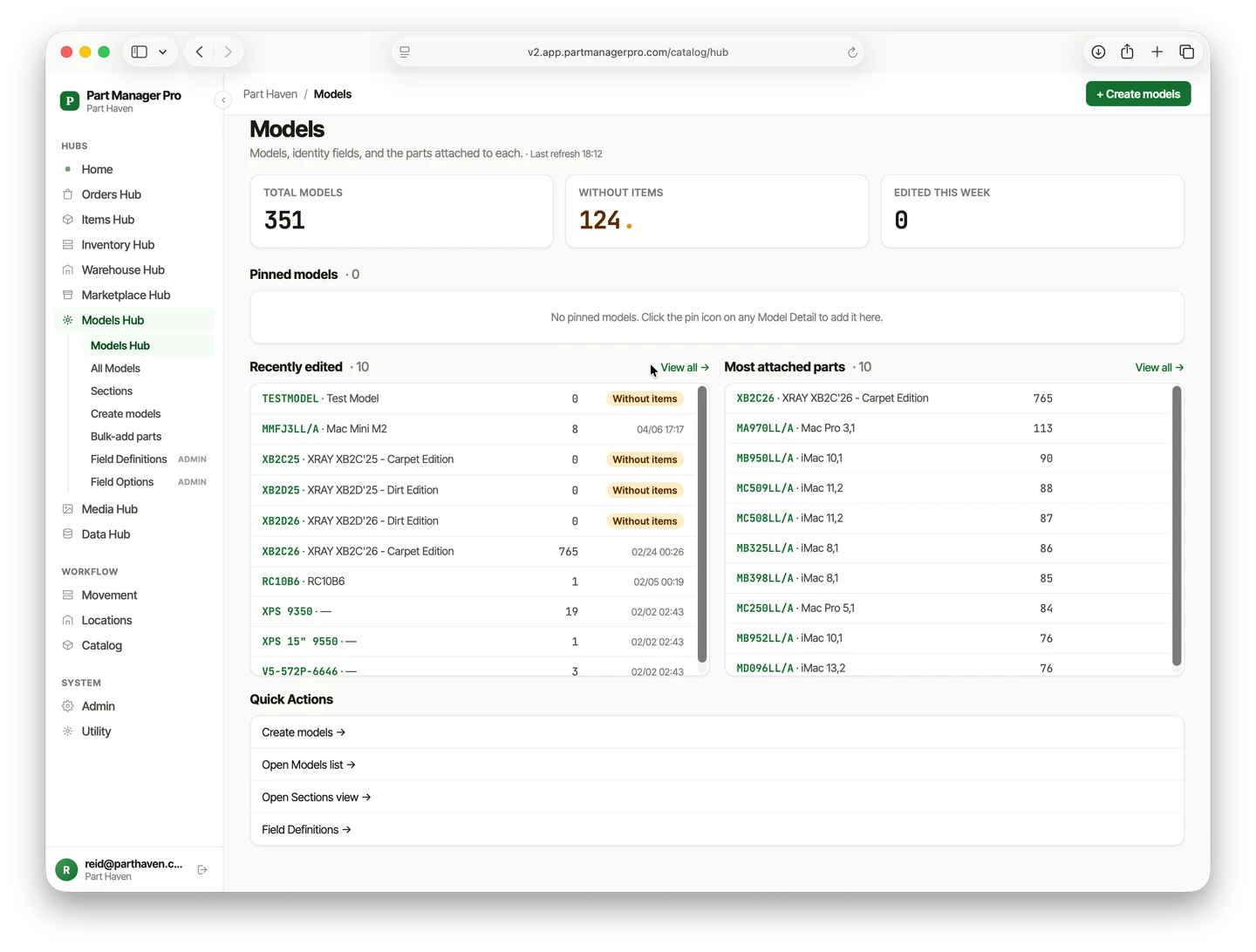
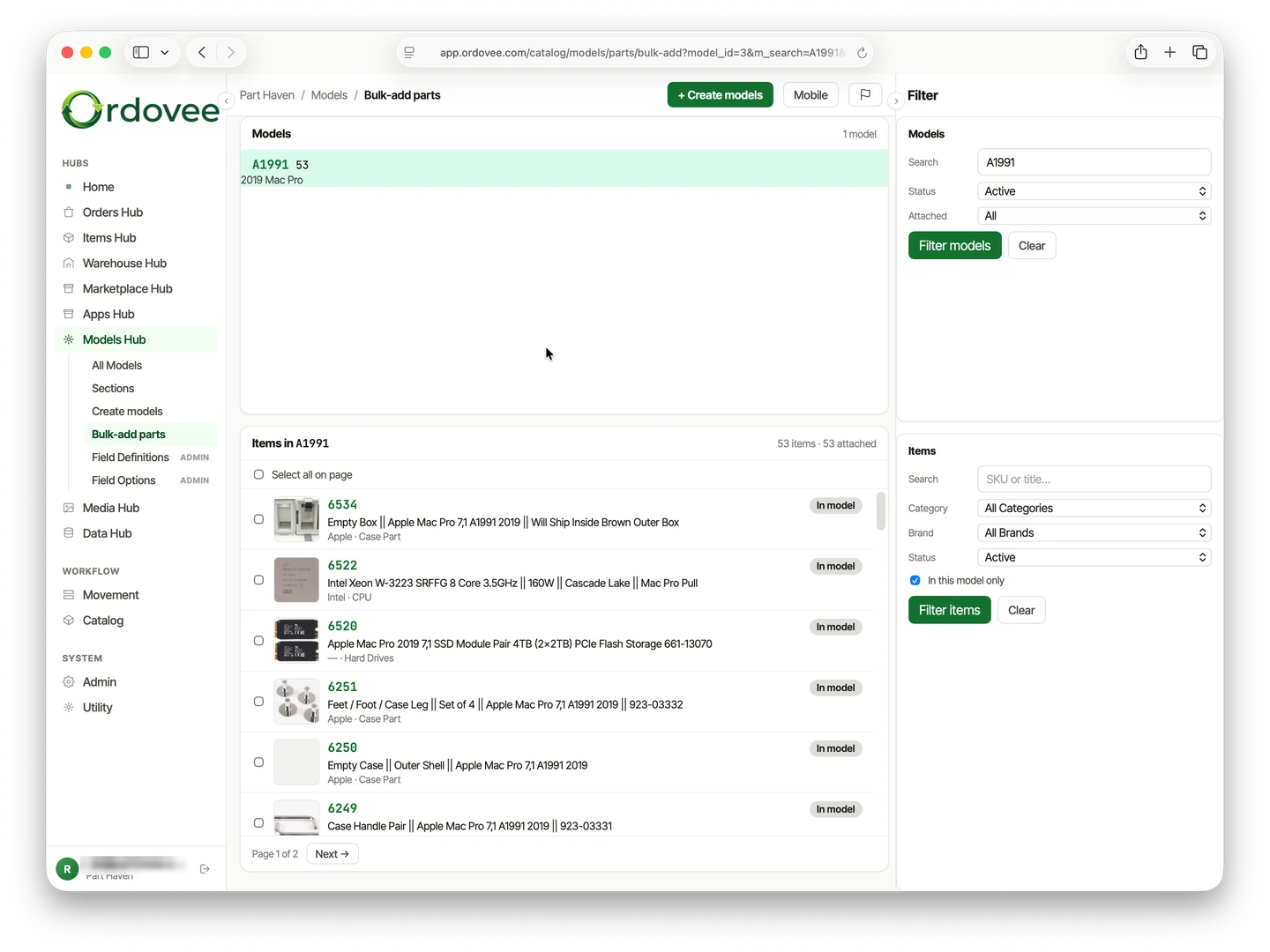
That is what Ordovee is for: a catalog recorded at teardown, searchable from both directions, owned by the business that built it. The catalog that pays you back is the one on your own shelves.
→ The same question for computers: Why don’t used computer parts have an interchange? → The system that solved it for one industry: What automotive interchange actually solved → Start with your own records: Build your own parts catalog · Parts compatibility cross-reference → See how ODV handles the whole part lifecycle: Product overview → Working out how to set yours up? Let’s talk
See Ordovee in your operation.
The fastest way to know if Ordovee fits your shop is to see the workflow with your own data — no slides, no scripted demo.