You hear a lot about AI right now, and most of it sounds like someone trying to sell you something. So here’s the straight version of how Ordovee gets built: where AI does the work, where it goes wrong, and where a person holds the line.
AI writes code here. Humans decide what ships.
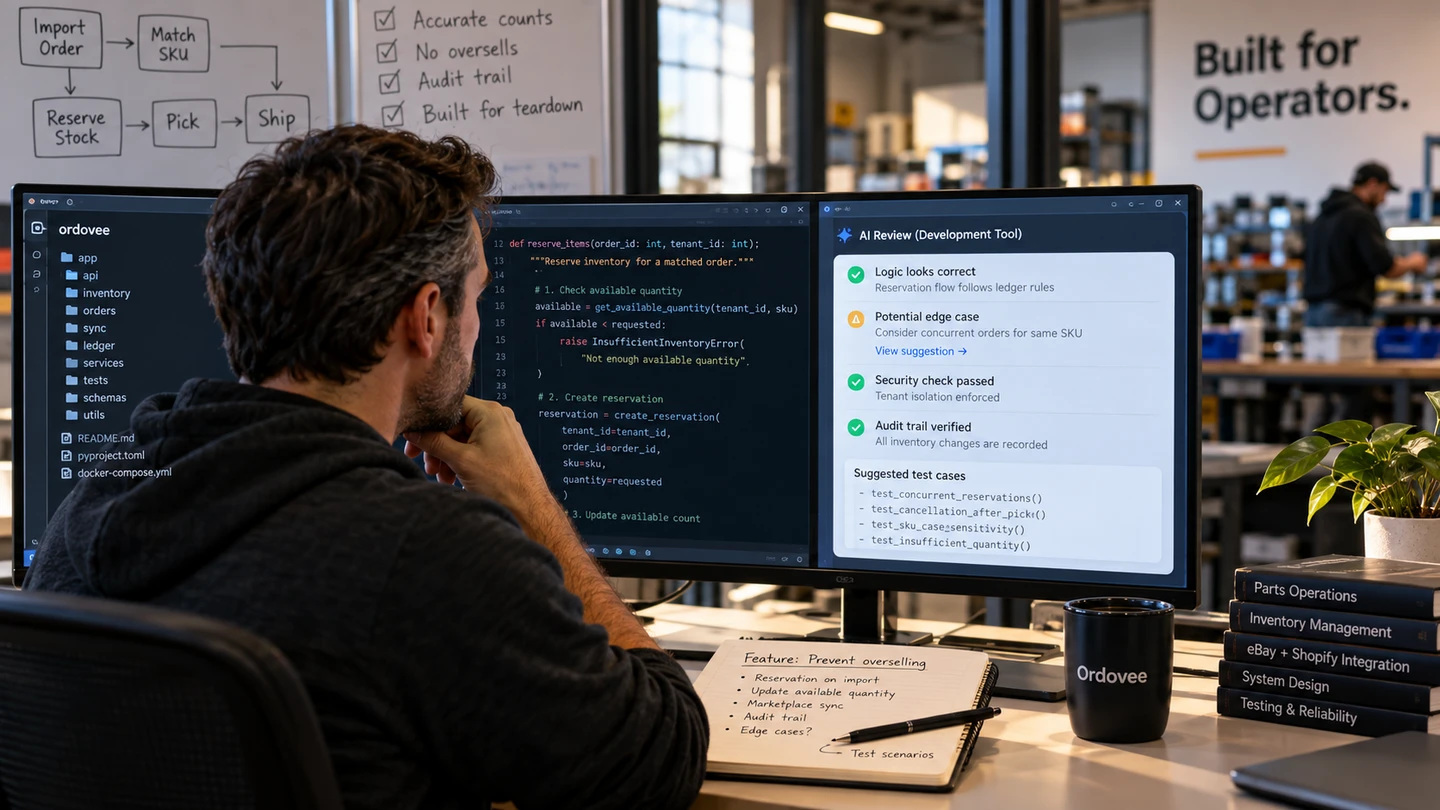
Ordovee is human-directed and AI-built. AI does a substantial amount of the implementation work: it writes code, drafts tests, and proposes changes. A person decides what should exist, what tradeoffs are acceptable, what findings matter, and what is allowed to ship.
We won’t tell you a person reads every line, because approving a change is not the same as reading every line of it. What is true is narrower, and it is the part that matters: every change crosses a human decision gate before it can ship.
The ideas still come from running a parts business. A feature like stopping the same part from selling twice on eBay and Shopify starts as a problem someone hit on a real warehouse floor. AI helps turn that into working software; it doesn’t decide which problem is worth solving next.
Where those ideas come from → What “designed for teardown” actually means
The bottleneck is on purpose
AI makes it cheap to chase the next interesting thing. An agent working on one problem notices another, a second path opens, and before long the work is solving six adjacent problems instead of the one it started with. When exploring another path costs almost nothing, uncontrolled wandering gets more dangerous, not less. So we deliberately put a human bottleneck back into the process.
Larger pieces of work run under a coordinator that owns the plan and writes a bounded brief for each piece. Anything an agent finds outside its brief gets reported rather than fixed on the spot, and the coordinator decides whether it belongs in the current work, gets parked, or becomes a job of its own. The coordinator doesn’t write code, and the sessions doing the work don’t talk directly to one another. Findings and decisions pass back through the person running the project.
The AI that writes the code doesn’t get the last word
“AI” isn’t one assistant here. The work is split into jobs that are deliberately kept apart:
- Builder — writes and changes things.
- Reviewer — read-only. Looks for defects and does not fix them.
- Coordinator — manages scope, rulings, and findings from the other jobs, without writing implementation code.
That separation matters because the agent that wrote something is poorly positioned to be the only one judging whether it is correct. For coordinated work, a fresh reviewer — a separate session that did not write the code — reviews a named version until no major findings remain. A reviewed version is frozen: if something changes afterward, it becomes a new version rather than quietly rewriting the one that was reviewed.
A green test isn’t enough
AI is very good at writing a test that looks convincing and passes. That doesn’t mean the test is useful. A test written alongside the code it checks can share that code’s blind spots, so “it passes” may only prove the two agree with each other.
For important fixes, we deliberately put the defect back and make sure the new test fails. A green test only means something if we’ve seen it turn red for the problem it claims to catch.
Claims get checked against the system
When an AI says “there are 27 of these,” that sounds precise. Precision isn’t proof. In one real case, an estimate of 27 affected records turned out to be 9 once someone ran the numbers — and the error ran in the direction that made the proposed fix look more worthwhile. That direction isn’t random, which is why the rule exists: important counts and product claims get checked against the code or the data rather than repeated because an AI sounded certain.
We hold our own guides to the same rule. A claim about what Ordovee does gets checked against the product’s code before we publish it, and when a published page turns out to be wrong, it gets corrected.
Then it has to survive the shop
Ordovee runs Part Haven, our own parts business, every day — the same workflows, handhelds, and screens you would use. So the path for a change doesn’t end at a passing test. It runs from a real operating need, to AI implementation, to automated checks, to an independent review, to a person’s approval, to the live product, and then to use on our own warehouse floor. When something goes sideways there, we trace it through the same records you would; here’s one of those days.
Part Haven proves that Ordovee can run a real parts operation. It does not, by itself, prove that every other operation works like Part Haven.
AI gets things wrong — so the process assumes it will
We don’t trust AI because it’s AI. We use AI because it can do a lot of work, then build a process around the ways it gets things wrong. Our own rulebook is full of rules that started as one of these:
- following documentation that had gone out of date
- describing a mechanism that doesn’t exist
- miscounting how big a change is
- writing a test that passes without proving anything
- fixing the right problem in the wrong place
- defending its own work instead of checking it
- missing something a fresh reviewer then caught
Each one has a rule written down beside it now, which is the point: the process learns from the failure instead of hoping it won’t repeat.
Rules that don’t bend
Ordovee has rules that aren’t allowed to become suggestions:
- Every inventory movement goes through the ledger.
- Every operation on account-owned data is required to stay scoped to that account. Cross-account access is treated as a critical defect.
- A handheld pick must identify the Location, SKU, and Tote before stock moves.
- Available quantity accounts for active reservations.
We write those rules down so the AI working on one feature does not get to quietly reinterpret them. Tests, reviewers, and code structure all check the same rules from different directions. Every order that moves through Ordovee crosses several of them — how an order moves from import to shipment shows where.
Is there AI inside Ordovee today?
No. There is no AI assistant inside the product today. AI is used in the development process, not as an operating layer inside your account.
That is deliberate. Our product framework puts any eventual AI assistance above the operating system, not underneath it. Inventory, orders, compatibility, locations, and the ledger need to remain structured records that stand on their own. If we add AI-assisted identification, compatibility research, listing drafts, or natural-language questions later, those tools will work over that structured data rather than becoming the source of it.
Where is the line between AI and human judgment?
The short list of what stays with a person:
- What to build, and for whom. Decided by someone who runs a parts business, after listening to operators on the floor.
- What’s in scope. The coordinator holds the fence; a person rules on anything found outside it.
- What ships. Every change crosses a person’s approval before it reaches the live product.
- Whether it works. Judged on our own warehouse floor, not only by a passing test.
The bottom line
AI lets a very small team build and review at a scale that would otherwise take far more people. But process, evidence, and a person’s judgment determine what ships.
We use AI aggressively. We also assume it can be wrong. So we built a development process that separates direction, implementation, review, evidence, and deployment — and keeps a human in control of the decisions that matter.
If you’re evaluating software and wondering what’s actually happening behind the screen, the honest answer is: a very small team, a lot of AI, and a person deciding what ships. We’d rather show you than tell you.
→ See how the full system works: Product Overview → Want a closer look at how Ordovee records changes? How the Audit Trail Works → Have a question about how this would work for your business? Let’s talk
See Ordovee in your operation.
The fastest way to know if Ordovee fits your shop is to see the workflow with your own data — no slides, no scripted demo.