You open the label tool, type a part number, and it asks one question you didn’t expect: QR code, or a 1D barcode? Pick the wrong one and you either can’t fit the code on a small sticker, or the scanner in someone’s hand can’t read what you printed. It’s a five-second choice that follows every part around the warehouse for years, so it’s worth understanding before you print a case of labels.
Here’s the short version, then the reasoning behind it.
The one-line answer for parts labels
For small part and location labels, a QR code wins. It holds far more data, scans from any angle, and stays readable on a 2” x 1” sticker or smaller — the size where a 1D barcode runs out of room. Reach for a 1D barcode only when a specific device or trading partner requires one.
That’s the whole decision for most shops. The rest of this guide explains why, and covers the cases where a 1D barcode is still the right call.
What QR and 1D barcodes actually are
A 1D barcode is the familiar row of tall stripes; a QR code is the square grid of little black-and-white cells. Both are just a way to print a code a scanner can read back — the difference is how much they can carry and how they have to be read.
A 1D barcode (the “1D” means one-dimensional — data runs left to right only) stores a short string in the width of its bars. The scanner has to see the whole strip end to end, with the beam crossing the bars at roughly the right angle, so the code needs a certain minimum width to stay reliable. Squeeze it too narrow and the bars blur together.
A QR code is two-dimensional: it stores data across a grid, both directions at once. That packs far more into the same footprint, and because the pattern reads in two dimensions, a scanner can decode it from any rotation — upside down, sideways, held at a tilt. If you want the formal definition, the barcode symbology glossary entry breaks down each format.
Why do parts shops reach for QR?
QR earns its keep on three fronts: it holds more data, it reads from any angle, and its built-in error correction survives the scuffs a warehouse hands out. On a small label, those three add up to fewer failed scans.
Density. A part number, a location code, sometimes both — a QR code fits all of it and has room to spare. A 1D barcode encoding the same SKU needs noticeably more width to stay scannable, which is exactly the width a small label doesn’t have.
It reads from any angle. When a picker grabs a part off the shelf and points a handheld at it, the label is never square to the scanner. A QR code doesn’t care — there’s no “right way up.” A 1D barcode wants its bars crossed by the beam at a reasonable angle, so an awkward grab means a re-scan.
Error correction survives the shelf. A part is a car alternator, a computer power supply, an HVAC blower, a tractor hydraulic fitting — it picks up grease, gets bumped, sits under fluorescent light for a year. QR codes carry error correction, so a code can still read when part of it is scuffed, smudged, or nicked. A 1D barcode with a damaged bar is often just a dead code you have to relabel.
Put together, that’s the difference between a label you print once and a label you re-print because a corner rubbed off. On a busy day, fewer re-scans is fewer stalls in the pick.
See it for yourself -> Print a QR part label and a 1D version of the same code, side by side, in about a minute: open the free label generator.
When does a 1D barcode still make sense?
A 1D barcode is the right choice when a device or a partner on the other end requires one. If that’s you, use CODE128 — it’s denser and has a built-in check that catches misreads, so it fits a narrow label better than CODE39.
A few situations call for 1D:
- An older scanner without a 2D imager. A laser-only scan engine reads stripes but not grids. Most phone and tablet cameras, and current Zebra handhelds, read both — but if you’re standardizing on hardware that only does 1D, print 1D.
- A trading partner or system that expects a 1D scan. Some receiving systems, ERPs, or partners want a specific 1D format on the label they scan. Give them what they read.
- A true retail product code. If you’re encoding an actual 12-digit retail product code, that’s what UPC-A is for. Use it only for that — not for your own internal part or location codes.
If you land on 1D, the choice between the two general-purpose formats is simple. CODE128 packs more characters into less width and includes a check digit that flags a bad read; CODE39 is older, wider, and has no built-in check. For an internal part or location code, CODE128 is the better fit on a narrow shelf label. Reserve UPC-A for retail product codes only — it can’t encode letters or a location like A-12-03 anyway.
What Ordovee prints
ODV prints QR by default for part and location labels, because it’s the format that stays reliable at small sizes. The free label generator lets you switch — QR, CODE128, CODE39, or UPC-A — so you can match whatever your scanners or partners expect.
That default is a deliberate part of how ODV approaches Structured Disassembly Management: one unit comes in, becomes many small parts, and each part needs a durable, scannable identity that fits a tiny sticker. QR handles that better than any 1D format, so it’s the starting point.
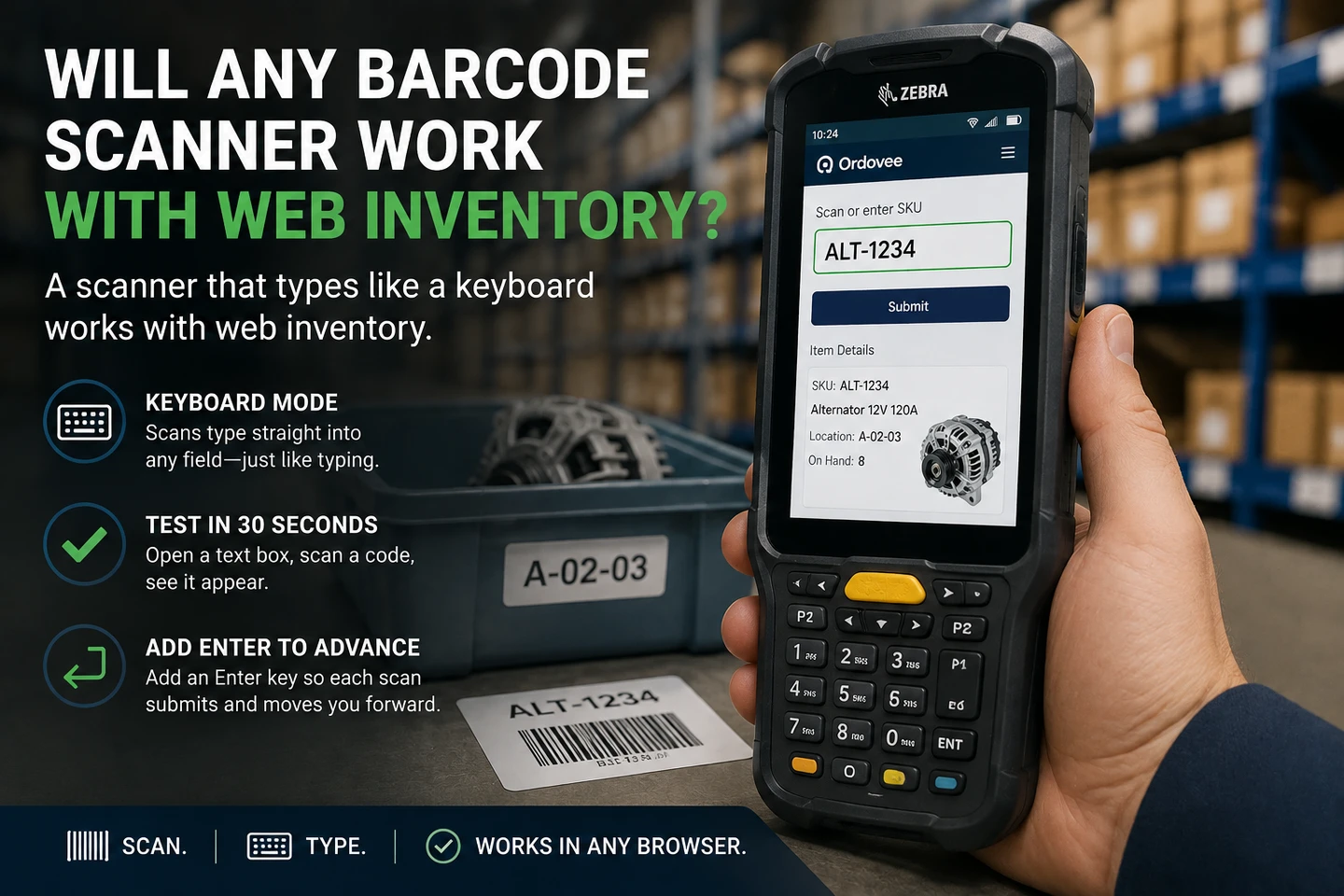
On the reading side, ODV doesn’t force a choice on your team. A phone or tablet camera reads QR codes and 1D barcodes directly, and a Zebra handheld with a 2D imager reads both formats once the right decoders are switched on — so a shelf full of QR labels and the occasional 1D label from a partner both scan without a second thought. The decoder settings that make that work live in the Zebra DataWedge setup guide; make sure the symbologies you actually print are enabled and you’ll never chase a “won’t scan” that’s really just a switched-off decoder.
One more factor decides how small you can go: the label itself. A QR code needs a minimum printed size to stay scannable, which is why the smallest 1” x 0.5” sticker still leaves room for one. Matching the code to the sticker — and to a material that survives grease and years on a shelf — is its own short decision, covered in the label sizes and materials guide.
Putting it to work
If you’re printing labels this week, the path is short: default to QR for parts and bins, keep CODE128 in your back pocket for the device or partner that needs a 1D scan, and confirm your scanners have the matching decoder turned on. Do that once and labeling stops being a decision you re-make every time.
→ Match the code to the sticker and a material that lasts: Pick the right label size and material → Print a QR or 1D label right now, no signup: Open the free label generator → Make one scanner read every format you print: Set up your Zebra decoders → See how a scanned label drives the whole pick: Walk through scanner-first picking → See where labels fit the full inventory system: Tour the Ordovee platform → Not sure which format your operation needs? Talk it through with us
See Ordovee in your operation.
The fastest way to know if ODV fits your shop is to see the workflow with your own data — no slides, no scripted demo.