What hardware do you need to run Ordovee?
ODV is a web application. If you have a browser and an internet connection, you can run it. There’s no software to install, no desktop client to maintain, and no proprietary hardware lock-in.
That said, a parts operation moves faster with the right tools. Here’s what ODV is designed to work with — and what we recommend.
Which barcode scanner should you buy?
Ordovee’s warehouse interface is built scanner-first: every picking session, inventory lookup, and bin assignment can be driven entirely by scanning — no typing required. If you want to see that flow end to end, the scanner-first picking guide walks a pick from location to confirmation.
Rugged warehouse scanners (recommended)
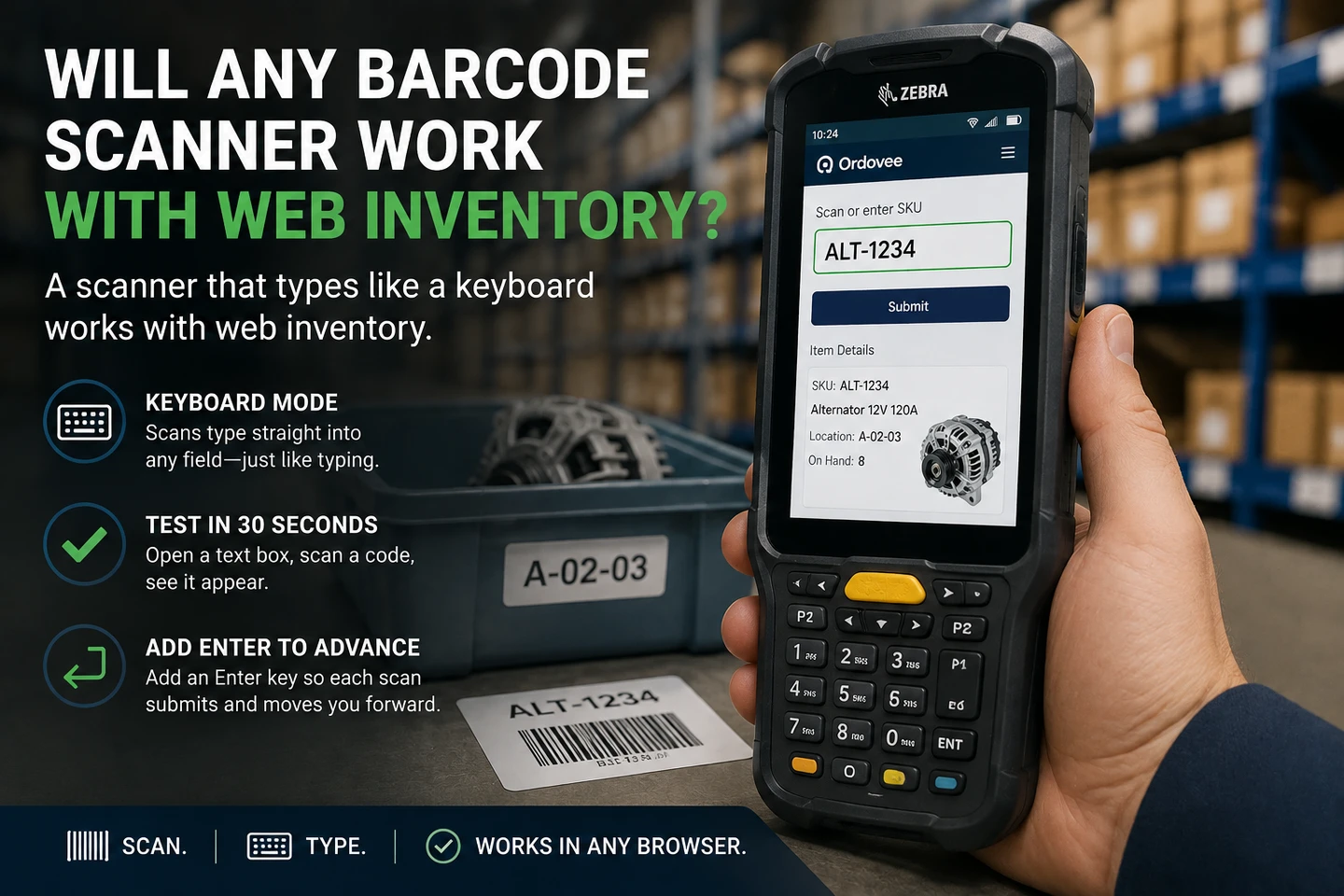
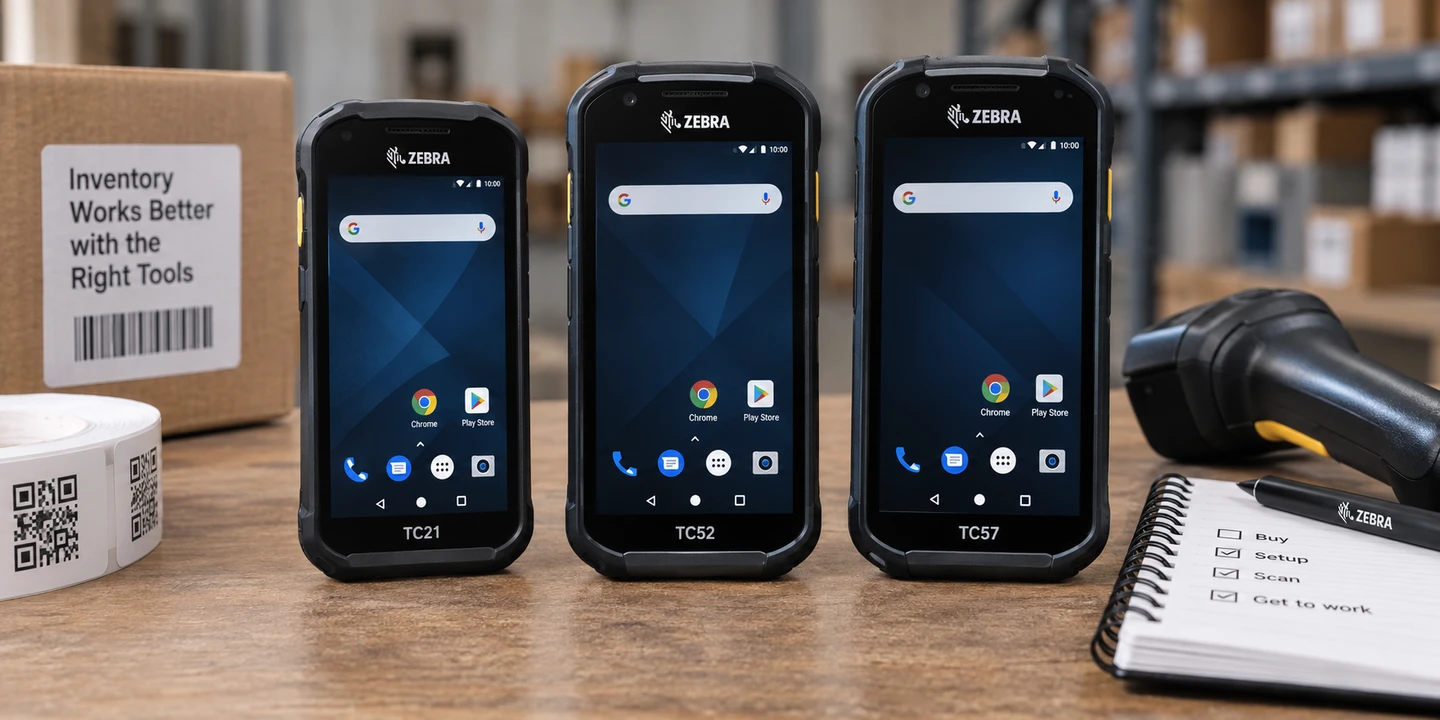
If your crew picks all day, a rugged handheld built for the warehouse earns its keep. Zebra’s warehouse handhelds are what most parts shops reach for — buying a used Zebra handheld walks through which model and what to check — and ODV knows them on sight — when a picker signs in on one, the screen shifts to a scan-built layout: big text, no scrolling, and each scan submits itself so nobody’s tapping a button forty times an hour.
There’s nothing to install and nothing to pair. The scanner behaves like a very fast keyboard, so the code lands in the screen the instant the picker pulls the trigger. That is keyboard-wedge mode, and it is the reason almost any barcode scanner works with web inventory — no driver, no plugin, and no brand you have to match. Open the browser, sign in, start scanning. Setting up a Zebra device the first time takes a one-time configuration — the Zebra DataWedge setup guide walks through it, and DataWedge in the browser covers the one setting that trips up fast scans in a web app.
The phone in your pocket
No dedicated scanner yet? A phone works. On an iPhone or iPod, ODV switches to a camera-first view — tap scan, point the camera at the QR code, and it reads instantly. Any Android phone does the same. If your team already carries phones, they can start scanning today, and you can add rugged handhelds later when the volume justifies it.
At the desk
No scanner at all is fine too. ODV runs in any desktop or laptop browser, where you type SKUs and location codes by hand. You won’t move as fast as a picker with a scanner, but nothing is locked behind hardware you don’t own.
What label printer works with Ordovee?
ODV generates labels as standard PDF files. Any printer that can print a PDF will work — but a thermal label printer is what most operations settle on.
What comes out of the printer
Most of what you print is small: part labels, location labels, and bin labels all land on a 2-by-1-inch sticker carrying the code plus a QR square a scanner can read back. Packing slips are the larger sheet — a 4-by-6 with the order details and a QR code the packer scans to confirm the right parts went in the right box. Every one of them is a plain PDF, so there’s no special label format to set up.
Which printer to buy
Any thermal label printer will do — Zebra, Dymo, Brother, and ROLLO all show up on parts-shop benches. Because ODV prints ordinary PDFs, you don’t have to match the printer to a particular label language or wonder whether it speaks the right dialect; if it can print a PDF, it can print your labels. Buy the one that fits your budget.
Most shops end up running two. The same 4-by-6 thermal printer you already use for carrier shipping labels turns out packing slips at the packing station, and a smaller 2-by-1 printer sits at the desk for part and bin labels. A regular office printer works in a pinch — you’ll just go through more ink and cut the labels apart by hand.
Want to see the label format before you buy? Print a sample from the free barcode label generator — no signup.
Batch printing
Labeling 200 bins? ODV builds a single multi-page PDF — up to 500 labels at once. Print the batch, peel, and stick. No clicking print for every label.
Cameras and photos
A clear photo is often what sells a part, so Ordovee gives every item room for up to 24 of them — the same limit eBay allows. You can snap them on your phone or camera, pull them in from an existing eBay listing, or drag them off your desktop.
ODV takes JPEG, PNG, and HEIF — HEIF being the format modern iPhones save by default — so your team can shoot and upload without converting anything first. Photos are stored securely, and ODV automatically makes the right-sized version for wherever a picture needs to appear, so nobody on your team ever thinks about resizing.
Browsers
Ordovee is a web app, so the browser is all you need to run it. It’s tuned for Chrome and Safari — everything behaves the same in both, with photo uploads being the one task that prefers Chrome. Mobile browsers on iOS and Android are supported too, and the handheld view adapts to whatever device signs in.
For the quick compatibility reference — exactly what we test and guarantee — see the hardware compatibility page.
What you don’t need
Ordovee is deliberately vendor-neutral, which keeps the shopping list short — all of this you can simply skip:
- No desktop software to install — everything runs in the browser.
- No special scanner software — rugged handhelds and phone cameras both work out of the box.
- No print server — labels go straight from the browser to the printer.
- No server room — ODV runs in the cloud and scales itself as you grow.
- No IT department — if you can open a web browser, you can run ODV.
What a real setup looks like
You don’t have to buy everything at once. Ordovee scales with the operation, and the hardware scales with it.
A single-station shop can run the whole thing on a phone and one printer. The phone handles scanning and photos, a 4-by-6 thermal printer turns out packing slips, and a laptop covers the admin work — orders, listings, reporting.
A mid-size shop usually puts a rugged handheld in each picker’s hand so the floor keeps moving, adds a 4-by-6 printer at every packing station, and keeps a small 2-by-1 printer running for bin and part labels. Desktops up front handle order management and reporting.
A large operation looks the same, just multiplied: a handheld for every picker, several packing stations each with their own printer, label printers stationed around the warehouse, and dedicated workstations for admin, orders, and reporting. Several pickers run their own picking sessions at the same time, and because each session stands on its own, one picker’s device losing power mid-run never touches anyone else’s work.
Getting started
Already have hardware? Ordovee works with it. Starting from scratch? A phone and a thermal printer get you running, and you can scale up when the volume asks for it.
Once the gear is sorted, the next thing worth reading is how the floor actually runs: scanner-first picking walks a pick from location to confirmation, and ledger-based inventory explains how every scan becomes a permanent count you can trust.
→ Questions about your own gear? Get in touch → See everything the platform does: Product Overview
See Ordovee in your operation.
The fastest way to know if ODV fits your shop is to see the workflow with your own data — no slides, no scripted demo.